UK Student Dependant Visa Rules for Nepali Students (2026)
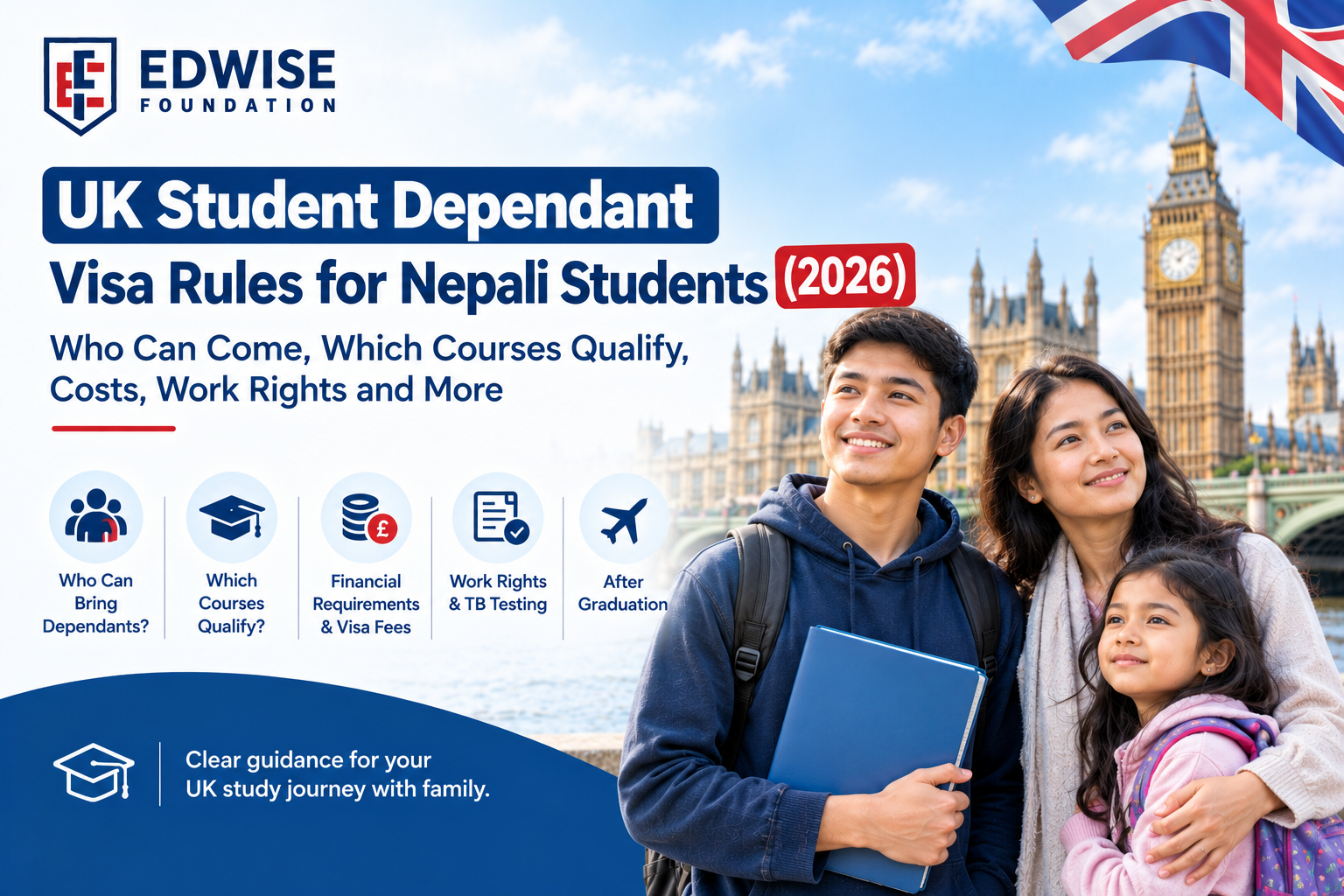
For most courses starting in 2026, Nepali students cannot bring a spouse or children as UK Student dependants unless they are studying a PhD, other doctorate, or a research-based higher degree (full-time, at least nine months), or are a government-sponsored student on a course over six months. A standard taught master’s does not qualify. Where dependants are allowed, each must show separate maintenance funds (currently £845/month London, £680/month outside), pay the £558 visa fee and £776/year IHS, and may need a TB test.
If you are planning to study in the UK from Nepal with your spouse or children, it is essential to understand the current Student dependant visa rules before choosing your course or university. The rules have become significantly stricter: under the rules applying in 2026, simply being accepted onto a postgraduate course does not automatically let you bring dependants.
Whether you can bring your spouse or children depends mainly on your course type, course duration and, in some cases, your source of sponsorship. This guide explains who qualifies, which courses count, the financial requirements, fees, work rights, TB testing, and what happens to dependants after graduation. It sits alongside our wider UK student visa process.
Who can bring dependants to the UK in 2026?
Under the current Student route, your partner and children may qualify as dependants only if you fall into one of these categories:
- You are a government-sponsored student on a full-time course lasting more than six months; or
- You are studying a full-time postgraduate course lasting at least nine months at an eligible higher education provider and — for courses starting on or after 1 January 2024 — the course is a PhD or other doctorate, or a research-based higher degree.
Starting most standard taught master’s degrees in 2026 does not let you bring a spouse or children as Student dependants, simply because the course is at master’s level. The old assumption that any postgraduate student can bring family is no longer correct.
Which UK courses allow dependants?
For new postgraduate students in 2026, what matters is not whether the course is a master’s — it is how the course is classified for UK immigration purposes. A qualifying course will generally need to be a PhD, another doctoral qualification, or a research-based higher degree — normally full-time, at least nine months, at an eligible provider. (Government-sponsored students have separate provisions for courses over six months.)
What counts as a research-based higher degree?
UKVI defines it as a postgraduate programme where the research component — including producing original work — is greater than any accompanying taught component, measured by student effort. The university must confirm the classification through your CAS. Do not assume a programme qualifies just because its title contains “research” or because it is a postgraduate degree. A conventional taught MSc, MA or MBA in 2026 would generally not qualify unless the institution formally classifies it as research-based for UKVI purposes.
Does an MRes allow dependants?
An MRes may allow dependants, but not automatically. For a 2026 start, the programme must meet UKVI’s research-based-higher-degree definition and the university must classify it accordingly. Confirm this with the university in writing before choosing the course or paying a deposit — do not rely on the course title alone.
Who counts as a UK Student dependant?
Qualifying dependants under the Student route can include your husband, wife or civil partner; your unmarried partner; and your child who is under 18 when applying. A child born in the UK during your stay may also qualify. Parents, siblings and other relatives cannot normally apply as Student dependants.
Spouse or partner
A marriage or civil partnership must be legally recognised where it took place. An unmarried partner must have been in a relationship similar to marriage or civil partnership for at least two years before applying, the couple must have met in person, and the relationship must be genuine and continuing. Keep appropriate evidence — a marriage/civil partnership certificate, plus additional relationship evidence where relevant.
Children
A child applying as a new dependant must normally be under 18 and not leading an independent life, with suitable care and accommodation arranged in the UK. Generally both parents must be applying together or already have UK permission, unless an exception applies (sole surviving parent, sole responsibility, or serious and compelling reasons). A child who entered under 18 and later turns 18 may, in some cases, keep extending as a dependant.
How much money is required for a dependant in 2026?
Each dependant must meet a separate maintenance requirement, in addition to the main Student applicant’s funds. As of now, the required funds per dependant are:
| Study location | Per dependant / month | Maximum (9 months) |
|---|---|---|
| London | £845 | £7,605 |
| Outside London | £680 | £6,120 |
These funds are normally required for up to nine months (or the length of permission if shorter). For example, a student outside London bringing a spouse and one child would need up to £6,120 + £6,120 = £12,240 for dependants, on top of their own maintenance and any outstanding tuition.
The UK is increasing Student maintenance funds for applications made on or after 30 November 2026 — the main applicant figures rise to £1,570/month (London) and £1,203/month (outside London). Dependant amounts are subject to the same annual uplift, so if you apply on or after 30 November 2026, confirm the exact current dependant figures on GOV.UK before you submit.
The 28-day financial evidence rule
Where financial evidence is required, the funds generally need to be held for at least 28 consecutive days, with the final day of that period within 31 days before the application date. Note that Nepal is not on the Student route’s differential-evidence list (Appendix Student ST 22.1), so Nepali applicants should be prepared to provide full financial evidence rather than assuming reduced documentary requirements. Applicants relying on government sponsorship or an international scholarship may use qualifying sponsorship evidence where it covers the relevant living costs.
Our UK team helps Nepali students confirm whether a course qualifies for dependants — before you choose a university or pay a deposit.
Book a free consultationVisa fees and the Immigration Health Surcharge
Each dependant makes an individual application and pays the applicable fees:
- Visa application fee: £558 per person (same as the main applicant).
- Immigration Health Surcharge (IHS): the reduced student rate of £776 per year per person. The exact amount depends on the length of permission granted, which can extend beyond the exact course dates.
The IHS is separate from the visa fee, the student’s maintenance requirement and the dependant’s maintenance requirement. Fees can change, so always check the latest amounts on GOV.UK immediately before applying.
Do dependants need a UK TB test?
In many cases, yes. GOV.UK guidance for Nepal requires a TB test for a UK visa when a person is coming for six months or more and both: they have lived in Nepal for six months or more, and they were living in Nepal (or another country on the UK’s TB-test list) within the previous six months. The test must be done at a Home Office-approved clinic — certificates from non-approved clinics are not accepted. This can apply separately to the student, spouse and each child where the conditions are met.
Can dependants work, study or claim benefits?
- Work: Eligible Student dependants are generally permitted to work — employment, self-employment and voluntary work — and there is no general 20-hour-per-week term-time cap of the kind that applies to many main Student visa holders. The main exception is that a dependant cannot work as a professional sportsperson or sports coach. For a spouse of an eligible PhD or research student, this usually means broader work rights than the student’s own visa.
- Study: Dependants may study in the UK. If a dependant is over 18 and will study a subject covered by the Academic Technology Approval Scheme (ATAS), they may need an ATAS certificate first.
- Benefits: No. Dependant permission is normally granted with a “no access to public funds” condition, so plan your finances without assuming any UK welfare benefits.
Timing, switching and what happens after graduation
Applying together or separately: A partner or child can apply at the same time as the student or separately later, as long as eligibility is still met. A separate application needs the student’s GWF or UAN number to link the applications. A dependant partner’s permission normally ends on the same date as the student’s; a dependant child’s generally ends on the earlier-expiring parent’s date.
Switching from inside the UK: Some people cannot switch into Student dependant status from within the UK — including those currently here as a visitor, short-term student, Parent of a Child Student, seasonal worker, or domestic worker in a private household. They would generally need to apply from overseas if otherwise eligible.
If you later move to the Graduate visa, a spouse or partner generally needs to have already been your dependant on your Student (or former Tier 4) visa to continue as a Graduate dependant. A new partner generally cannot join for the first time as a Graduate dependant. Plan family timing around this if it matters to you.
How Edwise Foundation helps
The single most important step for students hoping to bring family is confirming whether a course actually qualifies for dependants — and that is easy to get wrong from a course title alone. As Nepal’s first AIRC-certified and ICEF-screened education consultancy, Edwise Foundation has guided Nepali students since 2005. We help you check a programme’s UKVI classification before you commit, plan the additional dependant funds and documents, and prepare the linked applications correctly. With a 96% acceptance rate and 7,000+ students placed, we make sure your family plans rest on the actual rules, not assumptions. For the full picture, see our complete guide to study in the UK from Nepal.
Book a free consultation with our UK team before you choose a university or pay a deposit.
Book a free consultationFrequently asked questions
Official references
- GOV.UK — Student visa: your partner and children
- GOV.UK — Immigration Rules: Appendix Student
- GOV.UK — Financial evidence for Student and Child Student visa applicants
- GOV.UK — Immigration Health Surcharge: how much you pay
- GOV.UK — Tuberculosis testing in Nepal
- GOV.UK — Graduate visa: your partner and children
UK immigration rules, financial requirements and visa fees can change — including a maintenance-funds increase from 30 November 2026. This article is based on official information available at publication and is not legal advice. Always confirm the latest requirements on GOV.UK, and ask your university to confirm your course classification, before choosing a course or submitting a visa application.
You may also like


