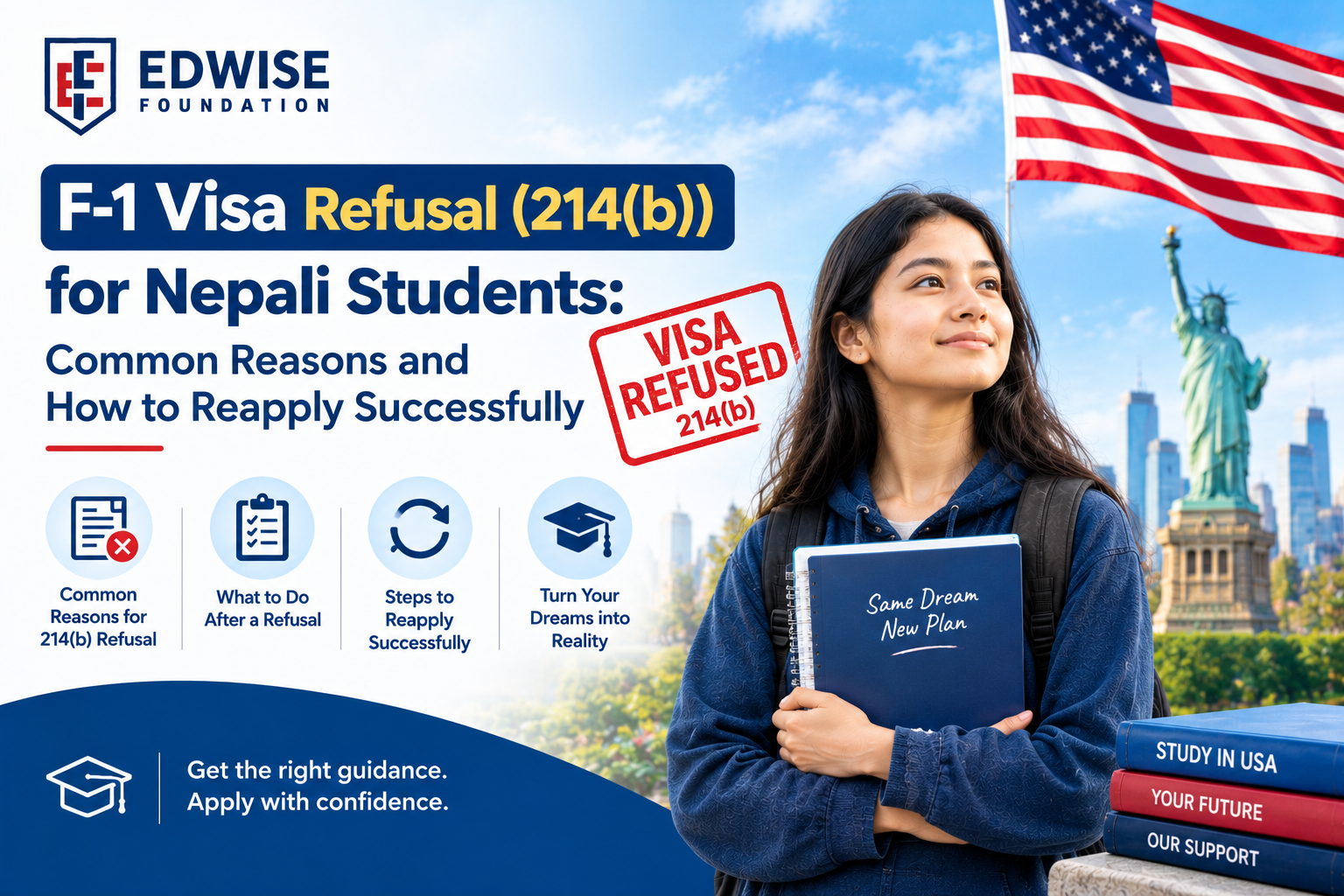
F-1Visa Refusal (214(b)) for Nepali Students: Common Reasons and How to Reapply Successfully
A Section 214(b) refusal means a consular officer was not convinced you qualify for the F-1 visa, usually because you did not clearly demonstrate your academic purpose or strong ties and intent to return to Nepal after studying. It is not permanent — there is no waiting period, and you can reapply with a new DS-160, a new fee and a new interview. The key to a successful reapplication is addressing the reasons for refusal and presenting new or improved information, not simply applying again unchanged.
Every year, thousands of Nepali students apply for an F-1 student visa to study in the United States. Many succeed, but some are refused under Section 214(b) of the US Immigration and Nationality Act (INA). A 214(b) refusal is disappointing — but it is not a permanent rejection, and it does not stop you from applying again.
This guide explains what a 214(b) refusal means, the most common reasons Nepali students receive one, and the steps that can improve your chances when you reapply. For broader interview preparation, see our guide to F-1 visa interview questions and answers.
What is an F-1 visa refusal under Section 214(b)?
Under US immigration law, every applicant for a nonimmigrant visa — including the F-1 student visa — is presumed to be an intending immigrant until they demonstrate otherwise. At the interview, the consular officer must be convinced that you qualify for the visa category and that you intend to return to Nepal after completing your studies.
A refusal under Section 214(b) generally means the applicant either did not sufficiently demonstrate eligibility for the F-1 category, or did not convince the officer of strong reasons to return home after studying.
A 221(g) case usually means your application needs additional documents or administrative processing, and is not a final decision. A 214(b) refusal is a final decision on that specific application — but it is not permanent, and you can reapply.
Common 214(b) refusal reasons for Nepali students
Most 214(b) refusals come down to one of these seven issues. Understanding them is the first step to a stronger reapplication.
1. Unclear academic purpose
A common reason is not clearly explaining why the chosen course connects to your previous education, work experience or career goals — for example, a management graduate applying for a highly technical program without a convincing explanation, or a student who cannot explain how the degree helps their career in Nepal. Officers look for a logical link between your past, present and future.
2. Weak career plans
Vague answers like “I will see what happens after graduation” or “I might stay in the US if I get an opportunity” raise concerns about temporary intent. A strong applicant explains specific career goals and how a US degree will help them contribute professionally after returning home.
3. Inability to demonstrate financial readiness
You must show sufficient funds to cover tuition and living expenses without relying on unauthorized work in the US. Financial documentation should be genuine, consistent and easily explainable.
4. Lack of knowledge about the university or program
Many students prepare for standard questions but stumble on detail — university location, program curriculum, duration, tuition costs, career outcomes. Answers that sound memorized or vague make officers question whether you genuinely researched your plans.
5. Weak home-country ties
Strong ties do not necessarily mean owning property. They can include family responsibilities, employment prospects, existing career opportunities, business involvement and long-term plans in Nepal. Officers assess whether you have compelling reasons to return.
6. Inconsistent or contradictory answers
Even minor inconsistencies can raise concerns — different explanations in your DS-160 and interview, conflicting financial information, unclear employment history, or different career goals mentioned at interview. Consistency and honesty are critical throughout.
7. Over-emphasis on employment opportunities
Students sometimes discuss part-time work, OPT or future jobs more than academics. The primary purpose of an F-1 visa is education — if the officer believes employment is the main motivation, it can harm the application.
Our US team runs mock F-1 interviews with Nepali students, reviews your finances and story, and helps you reapply with a stronger case.
Book a free consultationCan you reapply after a 214(b) refusal?
Yes. A 214(b) refusal is not permanent and there is no mandatory waiting period — you can apply again whenever you believe you can better demonstrate your eligibility. You will need to submit a new DS-160 form, pay the visa fee again, and attend a new interview.
When should you reapply?
Reapplying immediately without addressing the reasons behind the refusal usually does not change the outcome. A stronger reapplication may involve an improved understanding of your academic program, better-articulated career goals, updated financial documentation, additional work experience, or a significant change in your personal or professional circumstances. US authorities specifically note that applicants should ideally present new information or changed circumstances when reapplying after a 214(b) refusal.
Tips for a successful reapplication
- Be honest. Never submit false documents or misleading information — misrepresentation can lead to far more serious visa consequences than a 214(b) refusal.
- Understand your program thoroughly. Be ready to explain why this university, why this major, why study in the USA rather than Nepal, and how the degree helps your career.
- Connect past, present and future. Your story should make sense — educational background, current situation, academic goals and long-term career plans all fitting together.
- Know your finances. Be able to explain who is sponsoring you, how the funds were accumulated, and how tuition and living costs will be covered.
- Practise natural communication. Avoid memorized answers — officers conduct thousands of interviews and spot scripted responses quickly. Focus on understanding your own story.
What not to do after a refusal
- Do not create fake financial documents.
- Do not change your story dramatically.
- Do not memorize robotic interview answers.
- Do not hide previous refusals.
- Do not reapply repeatedly without any meaningful improvement.
A 214(b) refusal is feedback, not the end of the journey. Many Nepali students receive visas after reviewing their interview, strengthening their application and reapplying with greater clarity. The goal is not simply more documents — it is showing that your plans are genuine, financially realistic and connected to a clear future after graduation.
How Edwise Foundation helps
A 214(b) refusal is often about how a genuine student presented their case — which is exactly where preparation helps. As Nepal’s first AIRC-certified and ICEF-screened education consultancy, Edwise Foundation has guided students to the USA since 2005. Our advisors — many of whom studied abroad themselves — run realistic mock F-1 interviews, review your financial documentation and your academic story, and help you reapply with genuine clarity and confidence. We never guarantee approval (no one can), but with a 96% acceptance rate and 7,000+ students placed, we help you put your strongest honest case forward. For the full picture, see our complete guide to study in the USA from Nepal.
Book a free consultation with our US team for a mock interview and a full review before you reapply.
Book a free consultationFrequently asked questions
Official references
This article is for general informational purposes only and is not legal or immigration advice. Visa decisions rest solely with the consular officer, and no consultancy can guarantee approval. Always refer to official U.S. Department of State guidance for your situation.