Spring 2027 Intake for the USA: Timeline for Nepali Students
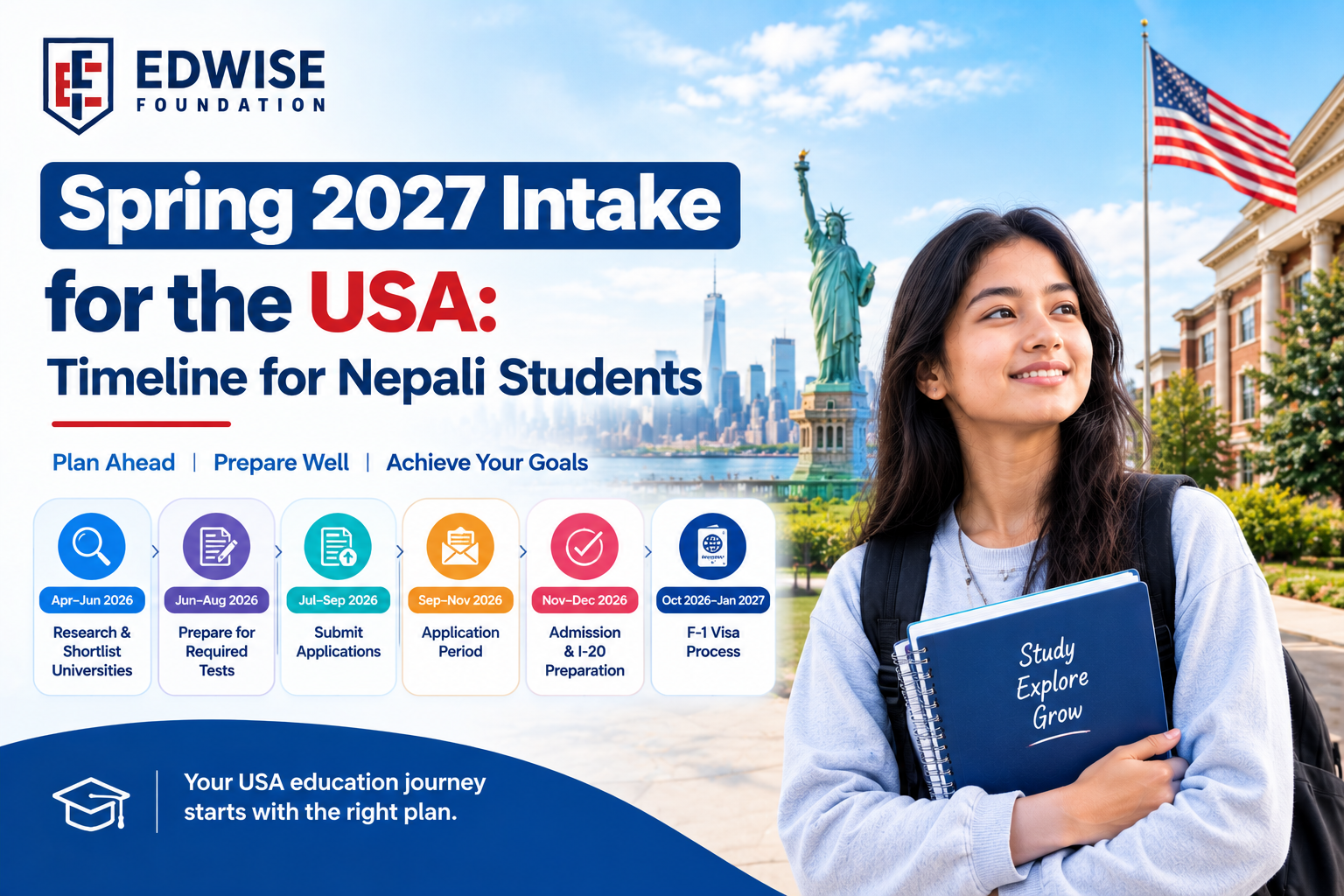
The Spring 2027 intake in the USA starts in January 2027, and is a good backup if you missed Fall 2026 or need more preparation time. Fewer universities and programs admit for Spring, so confirm your specific program accepts January starts. Plan around 8–9 months ahead: research and tests by mid-2026, applications by autumn, admission and I-20 by late 2026, then the F-1 visa (DS-160, $185 visa fee + $350 SEVIS fee). Visas can be issued up to 365 days before your start date, but you cannot enter the US more than 30 days before it.
If you missed the Fall 2026 intake, or simply need more time to prepare a strong application, the Spring 2027 intake in the USA is another option worth considering. Spring classes at US universities typically begin in January. Fewer universities and programs admit new students for Spring than for Fall, but it can still be a smart choice if you need extra time to prepare applications, improve test scores, arrange finances, or finish your previous studies.
Here is a realistic month-by-month Spring 2027 timeline for Nepali students, to help you plan ahead and avoid last-minute pressure.
Spring vs Fall intake in the USA
Fall is the primary intake in the United States — most universities and programs accept new students then, with the widest range of scholarships, assistantships and courses. Spring intake usually has fewer options: not every university or program admits students in January, and some admit only in Fall.
| Fall intake | Spring intake | |
|---|---|---|
| Starts | August / September | January |
| Universities & programs | Widest choice | Fewer options |
| Scholarships / assistantships | Most available | More limited |
| Best for | Most applicants | Those needing more prep time, later test scores, or finance time |
Spring can be a practical choice for students from Nepal who recently finished their previous studies, received test scores later than expected, needed more time to prepare applications, or required extra time to arrange finances.
Spring 2027 USA intake: month-by-month timeline
Ideally, plan for a January 2027 start around eight to nine months in advance. Timelines vary by university and program, but a typical schedule looks like this:
| When | What to do |
|---|---|
| Apr–Jun 2026 | Research and shortlist universities that actually offer Spring 2027 admission. Confirm your specific program — not just the university — accepts Spring students. |
| Jun–Aug 2026 | Prepare for and take required tests (IELTS/TOEFL; GRE/GMAT where required). Leave room for a retake if you want a better score. |
| Jul–Sep 2026 | Prepare and submit applications: transcripts, SOP, LORs, CV, test scores, credential evaluation and any program-specific documents. |
| Sep–Nov 2026 | Key application period — many Spring deadlines fall around here (though they vary widely). Submit well before the final deadline. |
| Nov–Dec 2026 | Admission decisions arrive. Compare offers, accept, pay any enrolment deposit, and submit the financial documents needed for your I-20. |
| Oct 2026–Jan 2027 | F-1 visa process: DS-160, pay fees, schedule and attend your interview once you have your I-20. |
| January 2027 | Travel to the USA in line with your university’s orientation and reporting schedule. |
If your admission and I-20 arrive early, you may be able to complete the visa process considerably sooner — giving you more time to prepare and travel.
The F-1 student visa process and fees
You don’t need to wait until December to begin. Once you are admitted, have your I-20, and are ready, you can start your F-1 application:
- Complete the DS-160 Online Nonimmigrant Visa Application.
- Pay the non-refundable student visa application fee, currently $185.
- Pay the SEVIS I-901 fee, currently $350 for F-1 students, before your interview.
- Schedule and attend your visa interview.
| F-1 fee | Current amount |
|---|---|
| Visa application fee (MRV / DS-160) | $185 |
| SEVIS I-901 fee | $350 |
New F and M student visas can be issued up to 365 days before the program start date on your I-20, so apply early rather than waiting until the final weeks. Interview wait times vary by location and season. Because government fees and procedures can change, always verify the current amounts on official U.S. government websites before paying.
A new F-1 student cannot enter the United States more than 30 days before the program start date on the I-20 — even if your visa is issued much earlier. Plan your travel around your university’s orientation and check-in schedule.
Our US team helps Nepali students find Spring-intake programs, build the timeline, and prepare the application, finances and F-1 visa.
Book a free consultationPrepare your financial documentation early
Financial preparation is one of the most important parts of the US study process. Universities normally require evidence of sufficient funds before issuing an I-20 — typically bank statements, sponsorship documents, scholarship or assistantship letters, and education-loan approval or sanction letters. Exact requirements and amounts vary by university.
Financial documentation also matters during the F-1 visa interview, where you should be ready to clearly explain how your education will be funded, with genuine supporting documents.
During 2026, some F-1 applicants in Nepal have reportedly been asked to provide up to two years of bank statements or transaction history as part of additional financial verification. This is not a published requirement that every F-1 applicant must submit two years of statements — but it does reinforce the importance of keeping clear, genuine, explainable financial records. Start discussing funding with your parents, sponsors, bank or loan provider while you are still shortlisting universities.
Common mistakes to avoid for Spring 2027
- Waiting too long to take IELTS, TOEFL, GRE or GMAT. Test dates and score-reporting timelines can create unnecessary delays.
- Assuming every US university offers Spring admission. A university may admit Spring students while your particular program does not — always check the program-level intake.
- Applying too close to the deadline. You need time after admission for financial verification, I-20 issuance, SEVIS payment, the DS-160, visa scheduling and travel.
- Underestimating visa and administrative processing time. Appointment availability varies, and some applications need extra administrative processing after the interview.
- Treating enrolment or deposit deadlines as flexible. Missing a required deposit or confirmation date can affect your admission.
- Preparing financial documents at the last minute. Your source of funds should be genuine, consistent and clearly explainable.
How Edwise Foundation helps
Every student’s timeline is different — your academic background, major, test scores, university choices, budget and scholarship expectations all affect when and where you should apply. As Nepal’s first AIRC-certified and ICEF-screened education consultancy, Edwise Foundation has guided students to the USA since 2005: we help you identify universities and programs offering Spring admission, guide your application, SOP and LOR, prepare your finances, and get you ready for the F-1 student visa from Nepal interview. With a 96% acceptance rate and 7,000+ students placed, starting early gives you more time to apply without last-minute pressure. For the full picture, see our complete guide to study in the USA from Nepal.
Book a free consultation with our US team to build your personalised Spring 2027 application and visa timeline.
Book a free consultationFrequently asked questions
Official references
Application deadlines, government fees and US visa procedures can change, and dates vary by university and program. This article is a general planning guide based on information available at publication. Always confirm Spring 2027 availability, deadlines and current fees with the individual university and official U.S. government websites before applying.