The F-1 Visa 4-Year Rule, Explained for Nepali Students (And Why It’s Currently Blocked)
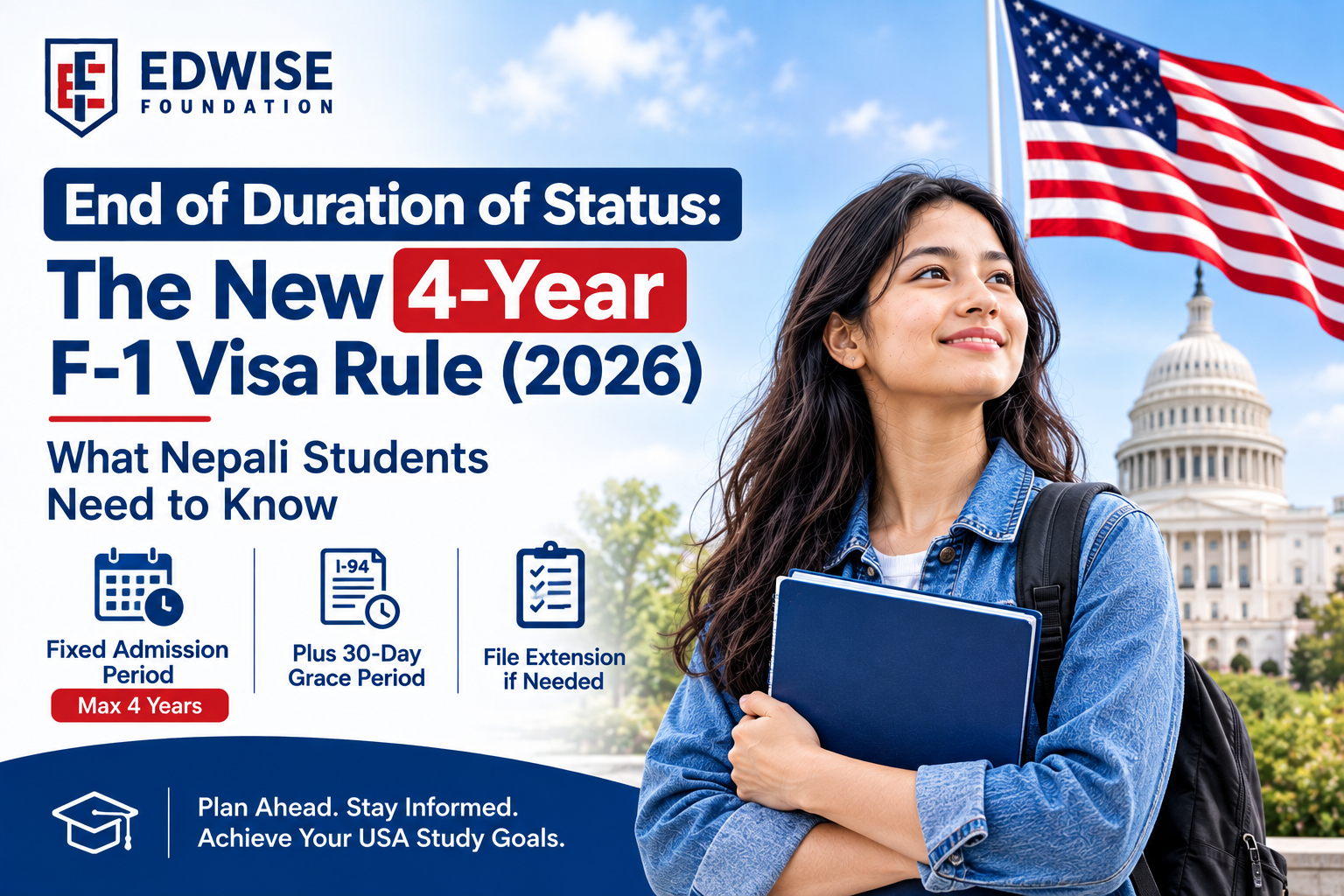
The so-called F-1 “four-year rule” — the DHS plan to replace Duration of Status with a fixed admission period capped at four years — was blocked by a US federal court on 14 September 2026, one day before it was due to take effect, and remains blocked while DHS appeals. As of now, Duration of Status still applies, the grace period is still 60 days, and there is no four-year cap or Extension-of-Stay requirement for simply taking longer to finish. This guide explains what the rule would have done if it returns — and what actually applies today.
For a long time, the F-1 student visa worked on a simple arrangement: as long as you were enrolled and followed your program, you could stay in the US for as long as your studies took. Your Form I-94 — the record of how long you are allowed to stay — simply said “D/S,” short for Duration of Status, with no expiry date to watch.
In July 2026, DHS published a final rule that would have ended that arrangement and replaced it with a fixed admission period capped at four years. But on 14 September 2026, a federal court blocked the rule, one day before its scheduled start — so it never took effect, and Duration of Status still applies. This guide explains, accurately, what is in force today and what the rule would change if the government’s appeal succeeds.
The F-1 four-year rule is blocked by a nationwide court order and is not being implemented. Duration of Status and the 60-day grace period still apply. DHS appealed on 30 September 2026; the First Circuit case is ongoing, so this position could change — check official sources before making decisions.
What is the current situation?
Here is the essential point before anything else: the four-year rule is not in effect. On 14 September 2026 — one day before it was due to start — a US federal court issued a nationwide injunction blocking the rule, and it remains blocked while the government’s appeal continues. In its own October 2026 court filing, DHS acknowledged the rule “has already been stayed in its entirety nationwide.”
So, for F-1 students right now:
- Duration of Status (D/S) still applies — you are admitted for the length of your program, not a fixed four-year period.
- The grace period is still 60 days after program completion — not the 30 days in the blocked rule.
- There is no fixed “Admit Until Date” and no Extension of Stay requirement for simply taking longer to finish.
DHS has appealed, so this could change in future. The rest of this guide explains what the rule would do if it ever takes effect, and why it is worth understanding now — but none of it is current law. For the focused update on the court decision, see our F-1 Duration of Status rule, explained.
What was “Duration of Status”?
Under D/S — which still applies today — an F-1 student’s authorized stay is tied to academic progress rather than a fixed date. You could take a two-year master’s or a six-year PhD and either way your Form I-94 simply said “D/S.” As long as your SEVIS record stayed active (full course load, valid I-20, no unauthorized work), you did not need to file anything with USCIS just because your degree took longer or you changed programs. It is flexible for students but, according to DHS, harder to monitor — which is what the blocked rule set out to change.
What the four-year rule would have changed
If the rule ever takes effect, F-1 students would be admitted for the length of their program as listed on the Form I-20, capped at a maximum of four years, plus a 30-day grace period (down from 60). Instead of “D/S,” the I-94 would show a specific admit-until date, which may not match the visa expiry or the I-20 end date.
- Programs shorter than four years (most bachelor’s and master’s) would get an admission period matching the program length plus the grace period.
- Programs running longer than four years — or students needing extra time — would have to file an Extension of Stay (EOS) with USCIS before the authorized period ends.
- It would apply to F-1 students and F-2 dependents, and to many students already in the US, subject to transition provisions.
Even under the rule, this would not be a lifetime four-year cap on US study. It would cap each individual admission or extension period. A standard two-year master’s would normally fit inside one admission period with nothing extra to file.
Who would need to watch the cap most closely?
If the rule takes effect, the students who would need to pay closest attention are those in longer programs — PhD candidates, combined bachelor’s programs, or anyone whose stay (including post-completion OPT) is likely to stretch beyond four years. For them, at least one Extension of Stay filing would become a normal part of the path to graduation. A standard two-year master’s student would likely never need to file anything extra.
Our US team helps Nepali students plan around the rules in effect today — and stay ready for whatever the appeal decides.
Book a free consultationHow the Extension of Stay (EOS) process would work
Under the rule, if you needed more time than your fixed admission period allowed, you would file Form I-539 (Application to Extend/Change Nonimmigrant Status) with USCIS before your authorized stay expired. Timely filing would matter a great deal:
Under D/S today, a student who falls out of status generally does not start accruing “unlawful presence” until USCIS or an immigration judge makes a formal finding. Under the blocked fixed-period system, missing an EOS deadline could start that countdown immediately — and unlawful presence can trigger three-year or ten-year bars on returning to the US. It is a real risk under the rule, but an avoidable one with timely filing. Remember: this applies only if the rule takes effect.
There is also a transition carve-out in the rule for current D/S students: those graduating in spring 2027 or earlier would not need a separate Form I-539 EOS if they file Form I-765 for post-completion or STEM OPT by 18 March 2027 — though a later STEM OPT extension could still require an EOS.
What the rule says about students already in the US
The rule’s transition provisions mean current F-1 students admitted under D/S would not have to rush to USCIS or the airport just because it took effect. They could generally continue under their current program period, or up to four additional years plus a 60-day departure period from the effective date — but not beyond 14 November 2030 — whichever comes first. Current students could keep travelling, but re-entering after the effective date could mean admission under a new fixed period.
Because the rule is blocked, none of these transition steps are required today. Whatever happens with the appeal, the right habit is the same: stay in close contact with your university’s international student office (DSO/ISSS) and monitor your I-20 and I-94 dates.
What this means for Nepali students planning US study
For most Nepali students heading into standard bachelor’s or master’s programs, the practical impact — even if the rule returns — is manageable. The bigger shift the rule would bring is a mindset one: under D/S you rarely think about immigration deadlines once you land; under a fixed-period system, missing a paperwork deadline could carry real immigration consequences even if you are doing everything right academically.
So if you are planning a longer program, or you know your plans include OPT or STEM OPT, it is worth building the EOS timeline into your thinking from day one rather than working it out in your final semester. Either way, choosing the right-fit program and major from the start — and tracking your dates — is the best protection against a changing rulebook.
How Edwise Foundation helps
A changing rulebook is exactly where good planning pays off. As Nepal’s first AIRC-certified and ICEF-screened education consultancy, Edwise Foundation has guided students to the USA since 2005. We help you choose the right-fit program and major from the start, track the dates that matter on your I-20 and I-94, and plan your OPT and any Extension-of-Stay timeline so nothing catches you off guard — whatever the appeal decides. With a 96% acceptance rate and 7,000+ students placed, our job is to keep your plan steady while the rules move. For the full picture, see our complete guide to study in the USA from Nepal.
Book a free consultation with our US team for guidance based on the rules in effect today.
Book a free consultationFrequently asked questions
Official references
Last updated October 2026. This article is general information, not legal advice. The 2026 DHS fixed-admission (four-year) rule is currently blocked by a federal court and is under appeal, so its status can change. Always check current DHS, ICE/SEVP and USCIS guidance, and speak with your university’s DSO or a qualified immigration attorney, before making any F-1 decision.