US F-1 Student Visa Rules 2026: The End of Duration of Status (D/S)
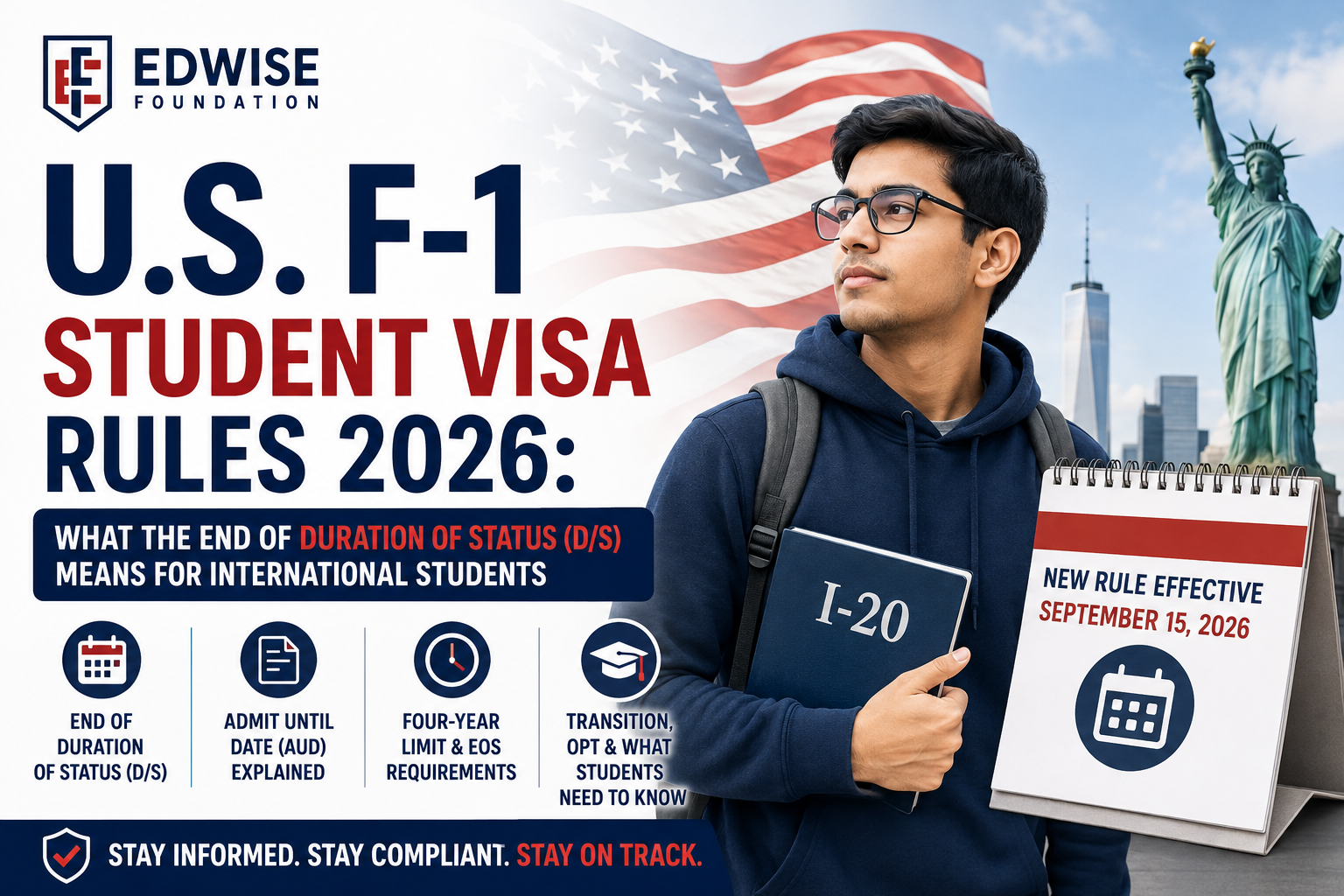
From 15 September 2026, the U.S. Department of Homeland Security replaced “Duration of Status” (D/S) with a fixed admission period for F-1 students. Instead of staying for as long as you maintain student status, you are now admitted until a specific Admit Until Date shown on your Form I-94, generally based on your program length up to a maximum of four years. If you need more time, you may have to file an Extension of Stay (Form I-539) with USCIS. Students already in the US under D/S are covered by transition rules and generally do not need to act immediately.
If you are an F-1 student in the United States — or planning to study there from Nepal — one of the most significant immigration changes in years took effect on 15 September 2026. The U.S. Department of Homeland Security (DHS) ended the long-standing “Duration of Status” system and replaced it with a fixed admission period. This guide explains, in plain terms, what changed, who is affected, and what Nepali students should check now.
What changed on September 15, 2026?
The U.S. Department of Homeland Security (DHS) changed how F-1 students and J-1 exchange visitors are admitted to the United States. Instead of being admitted for “Duration of Status” (D/S), students entering under the new system receive a specific date through which they are authorized to stay. This is commonly referred to as the Admit Until Date (AUD) and is shown on the Form I-94.
Under the new framework, the authorized admission period is generally based on the length of the academic program, subject to a maximum of four years. If a student needs additional time beyond the authorized period, an Extension of Stay (EOS) may be required through U.S. Citizenship and Immigration Services (USCIS), generally using Form I-539.
D/S vs Admit Until Date: the simplest difference
| Issue | Old D/S system | New fixed-admission system |
|---|---|---|
| I-94 | Usually showed D/S | Shows a specific Admit Until Date |
| Length of stay | Linked to maintaining valid student status | Program length, generally up to 4 years |
| Need more time | DSO/SEVIS program extension was central | USCIS EOS may also be required |
| Key date to monitor | I-20 and status requirements | I-94 Admit Until Date + I-20 |
How is the four-year period calculated?
For students admitted under the new fixed-period system, the four-year maximum is counted from the program start date on the Form I-20. The normal 30-day pre-program entry period does not count against the four-year maximum. A shorter academic program will normally result in a shorter admission period.
A student entering for a two-year master’s program would normally receive an admission period tied to that program rather than automatically receiving four years. A PhD program that extends beyond four years may require an EOS to complete the degree.
The transition period for students already in D/S
DHS did not require students who were already in the United States under D/S when the rule took effect to immediately file an EOS. The transition provision acts as a bridge from the old D/S system to the new fixed-date system.
In simple terms: an eligible student already admitted under D/S can generally continue until the program end date that applies under the transition rule, or the four-year transition limit, whichever comes first — unless an event such as international travel moves the student into the fixed-admission system.
For the September 15, 2026 effective date, the four-year transition point falls on September 15, 2030. Students whose programs extend beyond the applicable transition period may need to file an EOS if they require additional F-1 time.
Do current students need to apply for EOS immediately?
Generally, no. A student who is properly maintaining F-1 status and remains covered by the D/S transition provision does not file Form I-539 simply because the rule became effective. EOS becomes relevant when the student needs authorized F-1 time beyond the period permitted under the transition rules, or when the student becomes subject to a fixed Admit Until Date.
OPT and the March 18, 2027 transition cutoff
DHS created temporary transition relief for certain students who were already in D/S. A qualifying student who timely files for post-completion OPT or STEM OPT within the transition window — identified in DHS guidance as March 18, 2027 — does not need to submit a separate EOS application for that filing, provided the student remains eligible for the transition benefit.
March 18, 2027 is not a new or extended OPT application deadline. Students must still meet the normal OPT filing window. It is the cutoff for the special transition relief from the separate EOS requirement for qualifying D/S students.
Suppose an F-1 student was already in the US under D/S before the new rule took effect, remains eligible for the transition provision, and graduates in December 2026. If the student timely files the post-completion OPT application within the normal OPT filing window and within the special transition cutoff, a separate Form I-539 EOS is generally not required for that OPT filing.
Our US team helps Nepali students understand their I-94, I-20 and OPT timeline under the new fixed-admission rules.
Book a free consultationWhat about students graduating later?
A student who is currently a freshman or sophomore may remain protected by the transition rules while completing the degree, subject to the applicable transition limits. However, if that student applies for post-completion OPT after the temporary OPT transition relief has ended, the new EOS framework may apply.
How international travel can change your position
International travel is one of the most important issues for students relying on the transition provision. An F-1 student who departs the United States and re-enters on or after September 15, 2026 can be admitted under the new fixed-period system and receive a new I-94 with a specific Admit Until Date.
When can you file an Extension of Stay?
Under the new framework, an EOS may generally be filed up to 180 days before the student’s authorized admission period expires. The student normally needs an updated Form I-20 from the DSO and must file the required Form I-539 with USCIS before the applicable deadline.
- Examples can include needing additional time to complete a degree, dissertation or research.
- EOS may also become relevant for OPT or STEM OPT when the student’s authorized admission period does not cover the requested F-1 activity and no transition exception applies.
- Do not wait until the last moment, because USCIS processing time can affect planning.
What happens to the F-1 grace period?
For students under the new fixed-admission framework, the post-completion departure period is 30 days, and the Admit Until Date can include this period. Transition cases may be treated differently depending on the specific provision that applies, so students should verify their individual status with their DSO rather than applying a single grace-period figure mechanically to every existing D/S student.
Transfers, program changes and repeat degrees
The final rule also places tighter limits on some academic changes. Undergraduate students face restrictions on transferring or changing educational objectives during the first academic year, subject to limited exceptions. Graduate students face stricter limitations on transfers and changes of educational objective during a program. The rule also restricts pursuing another F-1 program at the same or a lower educational level.
F-2 dependents
An F-2 dependent’s authorized stay remains tied to the principal F-1 student’s status. If the principal student needs to file an EOS, dependent family members may also need the appropriate extension filing. A dependent should not assume that a later date appearing on their own I-94 allows them to remain after the principal student’s authorized stay ends.
What students should check now
- Form I-94 — especially the class of admission and Admit Until Date.
- Form I-20 — program start and program end dates.
- Passport validity — a shorter passport validity can affect admission in some circumstances.
- Travel plans — particularly if you currently rely on the D/S transition provision.
- Graduation and OPT timeline — including whether an EOS will be required.
- Any planned transfer, change of major, new degree or program extension.
How Edwise Foundation helps
Rules like this can feel overwhelming, but you do not have to navigate them alone. As Nepal’s first AIRC-certified and ICEF-screened education consultancy, Edwise Foundation has guided Nepali students to the USA since 2005. We help you understand your I-94 and I-20 dates, plan your OPT and STEM OPT for Nepali students timeline, and work with your university’s DSO so nothing is missed. With a 96% acceptance rate and 7,000+ students placed, our team keeps you informed as the rules evolve. For the full picture of studying in the USA, requirements and intakes, see our complete guide to study in the USA from Nepal.
Book a free consultation with our US team for guidance on the new admission rules, your OPT timeline and next steps.
Book a free consultationFrequently asked questions
Official references
This article is for general educational information and should not be treated as individualized legal advice. Because immigration implementation can change through litigation, agency guidance or later rulemaking, students should verify current requirements before filing or travelling.