Australia Student Visa Changes 2026: Major Updates Every Nepali Student Should Know
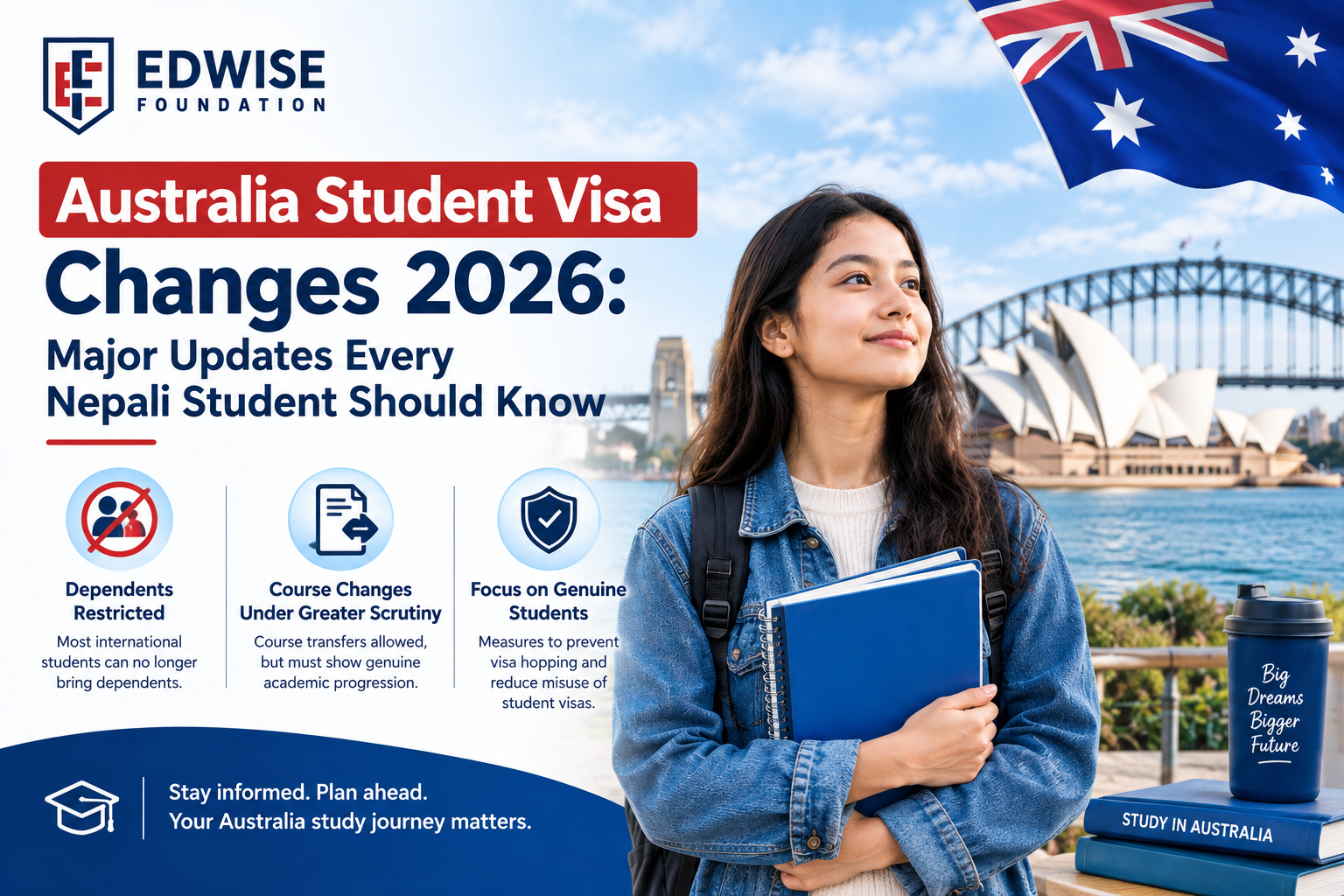
In September 2026, Australia’s Home Affairs Minister Tony Burke announced major migration reforms affecting international students. The three biggest changes for Nepali students are: most students will no longer be able to bring dependents (spouse or children); course changes and “visa hopping” will be tightened, with students generally expected to progress to higher-level courses; and visitor visas will carry a “No Further Stay” condition, closing the visitor-to-student onshore pathway. These reforms target misuse of temporary visas, not genuine students — but detailed rules and start dates are still being finalized.
Australia remains one of the top destinations for Nepali students seeking internationally recognized education, strong graduate outcomes and post-study opportunities. However, in September 2026, the Australian Government announced a new package of migration reforms that will significantly affect international students and their families.
The changes were unveiled by Australia’s Minister for Home Affairs, Tony Burke, as part of broader migration reforms aimed at strengthening the integrity of Australia’s visa system and reducing misuse of temporary visas. Importantly, these changes do not close Australia’s doors to genuine international students. Instead, they focus on restricting pathways the government believes have been used to extend stays without a genuine educational purpose.
For Nepali students considering Australia, there are three major changes that deserve particular attention.
Most international students will no longer be able to bring dependents
The biggest change announced by the Australian Government is the restriction on family members accompanying international students. Previously, many international students could bring their spouse and children to Australia, either through their initial visa application or through subsequent entrant arrangements. Under the new reforms, most student visa holders will no longer have automatic access to this pathway. The vast majority of international students will be expected to study in Australia without accompanying dependents.
Who may still be exempt?
The government has indicated that limited exemptions will continue to exist for certain categories, such as some higher-degree research students and specific regional arrangements. However, the general direction of the policy is clear: most international students will be expected to come alone.
What does this mean for Nepali students?
This change will have the greatest impact on married students, students with children, and mature-age applicants planning to relocate with family. Many Nepali students previously considered Australia attractive because a spouse could accompany them and potentially contribute to household income. Under the new rules, students should plan their finances assuming they will study independently rather than as a family unit.
Why has Australia made this change?
According to Minister Tony Burke, reducing the number of secondary applicants is part of the government’s broader strategy to manage migration levels and reduce pressure on housing and infrastructure. The government argues that international students often use dedicated student accommodation, whereas accompanying family members typically enter the wider housing market.
Course changes and “visa hopping” are being tightened
Another important reform affects students who change courses or repeatedly move between qualifications. The Australian Government has announced measures aimed at preventing what it describes as “visa hopping” — the practice of continually enrolling in new courses primarily to remain in Australia rather than for genuine academic progression.
Can students still change their course or major?
Yes. Students are not locked into their original course forever. If another program better suits your interests or career goals, course changes can still occur. However, these changes are expected to face greater scrutiny, and students may need fresh visa assessment depending on the circumstances. Course transfers must have a genuine academic rationale rather than being used simply to extend a stay in Australia.
Examples of legitimate academic progression may include:
- Business → Accounting
- Information Technology → Cybersecurity
- Engineering → Engineering Management
— provided there is a reasonable educational explanation.
What is actually changing?
The government’s primary focus is not preventing genuine course changes. Instead, it targets situations where students move into lower-level qualifications mainly to prolong their stay. Under the new approach, academic progression is expected to move upward rather than backward:
| Current qualification | Normal next step |
|---|---|
| Diploma | Bachelor’s degree |
| Bachelor’s degree | Master’s degree |
| Master’s degree | PhD |
By contrast, moving from a Master’s degree to a lower-level diploma primarily to obtain another student visa is exactly the type of pathway the government says it wants to restrict.
What does this mean for Nepali students?
Spend more time selecting the right institution and course before applying. While changing programs remains possible, repeated transfers or moves into lower-level qualifications may attract additional scrutiny. Students with clear academic goals and logical educational progression should continue to have viable pathways in Australia.
Visitor visa holders will face a “No Further Stay” condition
A third major reform affects visitor visa holders. The Australian Government has announced that visitor visas will carry a “No Further Stay” condition designed to ensure they are used only for genuine temporary visits. Under this approach, visitors will generally be unable to apply for another visa while remaining in Australia, and will instead need to leave the country before making a new application.
Why is this significant?
For years, some individuals entered Australia on visitor visas and later applied for different visa categories while already inside the country. Once an onshore application was lodged, many could remain in Australia on bridging visas while waiting for a decision. The government argues this created unintended pathways for long-term stays and contributed to misuse of temporary visas. The “No Further Stay” condition is intended to close that loophole.
What does this mean for Nepali students?
Avoid planning future study pathways around the assumption that you can enter Australia as a visitor and later switch to another visa category from within Australia. Instead, prepare the correct visa application from the outset and follow official immigration procedures.
Our team helps Nepali students plan around the latest rules — course choice, finances and the right visa pathway from the start.
Book a free consultationShould Nepali students be concerned?
The short answer is no — provided they are genuine students. The recent reforms are not designed to stop international students from studying in Australia. Universities continue to welcome qualified applicants, and Australia remains committed to international education. What has changed is the government’s approach to:
- Bringing family members on student visas
- Repeated course changes for migration purposes
- Visitor-to-other-visa pathways
- Long-term visa hopping strategies
Students whose primary goal is education and career development should still find Australia an attractive destination.
What should Nepali students do now?
Before applying, students should:
- Plan for the possibility of studying without accompanying dependents.
- Choose the right course and institution from the beginning.
- Ensure future study plans demonstrate genuine academic progression.
- Avoid relying on visitor visa pathways for future migration plans.
- Stay informed about policy changes before submitting applications.
- Seek professional guidance to understand how the new rules may affect their individual circumstances.
At the time of writing, these reforms have been announced by Australia’s Minister for Home Affairs, Tony Burke, as part of the government’s broader migration reform agenda. Detailed legislative instruments, policy guidelines and implementation instructions have not yet been fully published. Exact eligibility criteria, exemptions, transition arrangements and commencement dates may become clearer once the formal written policy is released. Treat the current announcements as a clear indication of the government’s intended direction, and keep monitoring official updates from the Australian Department of Home Affairs and your education provider.
How Edwise Foundation helps
Australia’s visa landscape is evolving, and understanding the latest regulations is essential before making major education and financial commitments. As Nepal’s trusted international education consultancy since 2005 — AIRC-certified and ICEF-screened — Edwise Foundation provides personalized guidance on university selection, admissions, scholarships, Australia student visa requirements and the latest policy updates affecting Nepali students. Whether you are planning a Bachelor’s degree, Master’s program, research qualification or pathway course, our experienced counsellors help you make informed decisions and choose the right academic pathway from the very beginning. For the full picture, see our complete guide to study in Australia from Nepal.
Book a free consultation with our team to understand how the new rules may affect your plans.
Book a free consultationFrequently asked questions
References
This article is for general informational purposes only and is not immigration or legal advice. Australia’s migration reforms are being implemented over time and details can change — always check the latest guidance from the Australian Department of Home Affairs and your education provider before making decisions.