
Pre-CAS Interview for Nepali Students: Questions & How to Answer
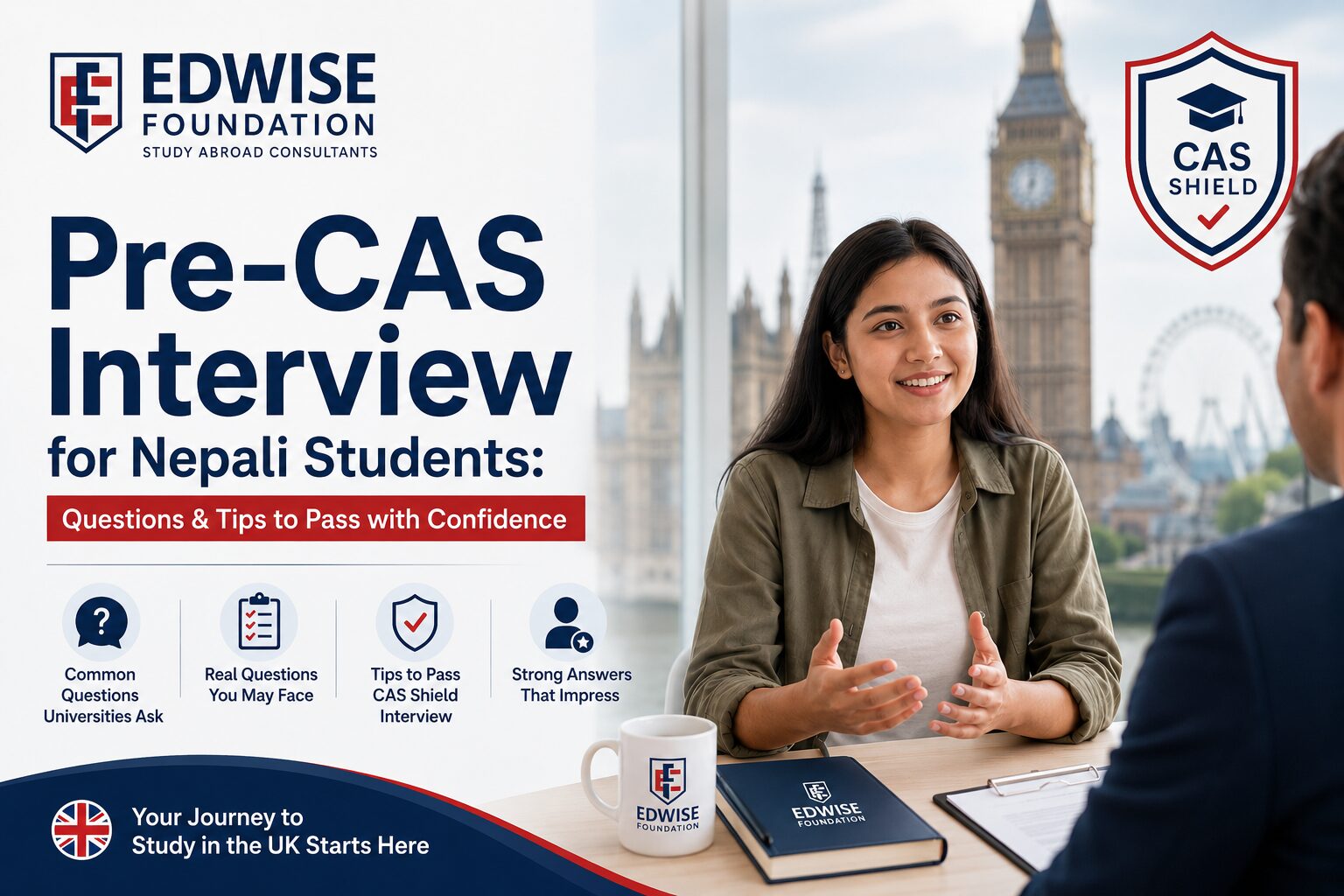
A pre-CAS interview is a short online interview a UK university conducts before issuing your Confirmation of Acceptance for Studies (CAS). For Nepali students, it is used to confirm you are a genuine student who understands your course, your finances and your plans. Many UK universities now treat it as mandatory for applicants from Nepal, and you must pass it to receive your CAS and move on to the student visa stage.
If you are applying to a UK university from Nepal, the pre-CAS interview is one of the most important — and most misunderstood — steps in your journey. It is the moment a university decides whether to trust you with a CAS, the document you cannot apply for a student visa without. The good news is that it is entirely possible to walk in prepared and confident. This guide explains exactly what the pre-CAS interview involves for Nepali students, the questions you are likely to face, and how to answer them well.
What is a pre-CAS interview?
A pre-CAS interview is a short interview conducted by your chosen UK university, usually online, before it issues your Confirmation of Acceptance for Studies (CAS). It is carried out on a system called CAS Shield as part of the university’s assessment of your application.
UK universities are licensed student sponsors, and the Home Office requires them to endorse only genuine students. The pre-CAS interview is how they meet that responsibility. Nepal appears on the list of countries whose applicants are commonly required to sit this interview, alongside India, Sri Lanka and several others. In practice, this means most Nepali students applying to UK universities should expect one — and should prepare for it seriously rather than treating it as a formality.
If you cannot answer the questions convincingly, the university can decline to issue your CAS, which stops your visa application before it begins. Passing it, on the other hand, moves you straight to the CAS and visa stage.
Pre-CAS interview vs credibility interview: what’s the difference?
These two interviews are often confused, partly because universities do not always use the same name for them. Some universities call their own pre-CAS check a “credibility interview,” while UK Visas & Immigration (UKVI) runs a separate credibility interview of its own. In other words, a credibility interview can be conducted either by your university, as part of the pre-CAS stage, or by UKVI during your visa application. The table below shows exactly who runs what.
| Feature | University Pre-CAS / Credibility Interview | UKVI Credibility Interview |
|---|---|---|
| Conducted by | Your university’s admissions or compliance team | UK Visas & Immigration (UKVI) — Home Office |
| When | Before your Confirmation of Acceptance for Studies (CAS) is issued | During your Student visa application, if selected by UKVI |
| Purpose | Assess whether you are a genuine student and decide whether to issue your CAS | Assess whether you are a genuine student and decide whether to grant your Student visa |
| Stage | University admission process | UK Student visa application process |
| Mode | Usually online via Microsoft Teams, Zoom, CAS Shield or another university platform | Video call, telephone, or at a Visa Application Centre, depending on UKVI |
| Mandatory? | Required by many UK universities, especially for higher-risk applicants or regions | Only selected applicants are asked to attend |
| Main focus | Course choice, university selection, academic background, finances, English ability and future career plans | Your study plans, finances, English ability, immigration history and the Genuine Student requirement |
| Outcome | University decides whether to issue your CAS | UKVI decides whether to approve or refuse your Student visa |
| Final decision | The university | UKVI (Home Office) |
The helpful part is that the questions overlap heavily. Preparing well for your university’s pre-CAS interview is effectively a rehearsal for the UKVI credibility interview, should you be selected for one later.
How the pre-CAS interview works
Once you have an offer and have met the conditions, the university’s team invites you to schedule the interview. Here is what to expect:
- Format: An online video call, usually on Microsoft Teams, Google Meet, Zoom or Skype. A webcam is normally required so the interviewer can confirm your identity against your passport.
- Length: Typically 20 to 40 minutes, one-to-one with a member of the admissions or compliance team.
- Language: Conducted in English. Because of this, your spoken English is also being assessed, even when you have already submitted IELTS, PTE or an MOI letter.
- Invitation: Sent by email, so check your inbox and spam folder regularly and reply promptly to book a slot.
- Attempts: You usually get up to two attempts, but still treat the interview as the real thing and prepare fully.
Join five minutes early from a quiet room with a stable internet connection, good lighting and your passport and offer letter beside you. A calm, professional setting makes a genuine difference to how confident you come across.
What interviewers are really assessing
Behind every question is a single goal: confirming that you are a genuine student with a realistic, well-researched plan. Interviewers are quietly checking whether you can show:
- Genuine intent — that you are coming to the UK to study, not for another reason.
- Course knowledge — that you understand what you will study and why it suits you.
- Informed choices — that you researched the university, city and course yourself.
- Financial readiness — that you know your costs and how they will be met.
- A clear future — that your studies connect to a sensible career direction.
You do not need perfect, scripted answers. You need honest, specific ones that clearly belong to you and your own situation.
Common pre-CAS interview questions by topic
Questions are tailored to your application, but they almost always fall into these groups. Prepare a personal answer for each:
| Topic | Questions you may be asked |
|---|---|
| About you | Introduce yourself. What is your academic background? Do you have any study gaps, and what did you do during them? |
| Why the UK | Why do you want to study in the UK rather than Nepal or another country? |
| Why this university | Why did you choose this university? Where is it? Which campus and city will you study in? |
| Your course | Why this course? What modules will you study? How is it assessed? How long is it? |
| Finances | How much are your tuition and living costs? Who is funding you? How were the funds arranged? |
| Accommodation | Where will you live? Have you looked into housing costs? |
| Future plans | What do you plan to do after you graduate? How does this course help your career? |
Strong vs weak answers: real examples
The difference between passing and struggling is rarely the question — it is the quality of the answer. Compare these:
“Why do you want to study in the UK?”
“The UK is a nice country, people speak English, and I have relatives there. It is easier to get a visa and I can work part-time.”
“The UK offers a one-year master’s in my field, which lets me specialise quickly. My chosen university has strong industry links in this area, and a UK degree is well recognised by employers back home in Nepal, where I want to build my career.”
“Why did you choose this course?”
“It is a popular course and my agent suggested it. I think it has good job opportunities.”
“I chose the MSc in Data Science because I completed a BSc in Computer Science and want to move into analytics. Modules like machine learning and data visualisation match the skills I need, and the course includes a practical project I can use in my portfolio.”
“How will you fund your studies?”
“My family will manage it somehow. I am not sure of the exact amount.”
“My tuition is around £15,000 and I have budgeted for living costs on top of that. My parents are my sponsors, and the funds have been maintained in our account to meet the visa requirement. I can explain the source of the funds clearly.”
Notice the pattern: strong answers are specific, personal and researched. They name real details about the course, the costs and the plan.
Our UK advisors run practice interviews with Nepali students and give honest feedback on your answers, so you walk in prepared.
Book a free consultationHow to prepare for your pre-CAS interview
Preparation is straightforward when you know where to focus. Work through this checklist:
- Re-read your SOP. Your answers should match the story you told in your statement of purpose.
- Study your course page. Know the modules, duration, assessment methods and campus location by heart.
- Know your numbers. Be ready to state your tuition, living costs, and who is funding you and how.
- Prepare your “why” answers. Why this course, why this university, why the UK — in your own words.
- Explain any gaps. If you have a study gap, describe honestly what you did during it.
- Practise out loud. Rehearse with a friend, family member or advisor until your answers feel natural, not memorised.
- Test your tech. Check your camera, microphone and connection the day before.
Common mistakes Nepali students make
- Memorising answers word for word. Rehearsed scripts sound rehearsed. Interviewers can tell, and it works against you.
- Being vague about money. Not knowing your tuition or funding source is one of the biggest red flags.
- Not researching the university. Being unable to name your city, campus or a single module suggests the choice was not yours.
- Over-emphasising work. Focusing on part-time jobs rather than study raises doubts about your intentions.
- Guessing when unsure. It is fine to politely ask for a question to be repeated rather than answering blindly.
- Treating it casually. Poor lighting, background noise or arriving late all undercut a genuine impression.
Handled well, the pre-CAS interview is not an obstacle — it is your chance to show a real person behind the application. Be honest, be specific, and let your own reasons come through.
How Edwise Foundation helps you prepare
As Nepal’s first AIRC-certified and ICEF-screened education consultancy, Edwise Foundation has guided Nepali students through UK admissions since 2005. Our advisors, many of whom studied abroad themselves, run realistic mock pre-CAS interviews, review your answers on course, funding and future plans, and help you present your case honestly and confidently. With a 96% acceptance rate and 7,000+ students placed, we focus on matching you to the right course so your reasons are genuine and easy to explain. For the full picture of applying to UK universities, requirements and intakes, see our complete guide to study in the UK from Nepal.
Book a free consultation with our UK team and get a personalised practice session before your interview.
Book a free consultationFrequently asked questions
You may also like


