Studying in the USA After the 2026 F-1 Rule Changes: What Nepali Students Should Know
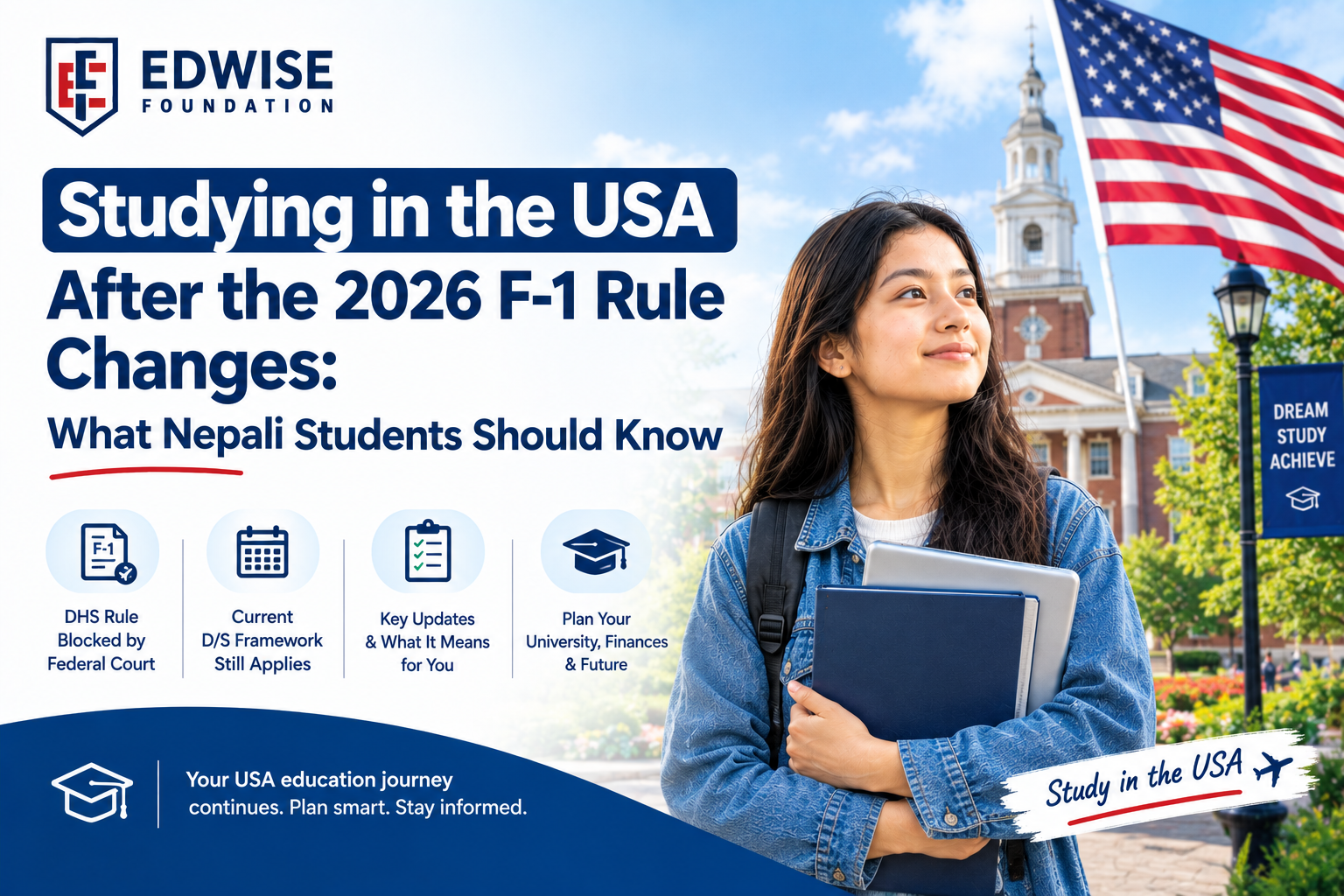
The DHS F-1 rule published on 17 July 2026 — which would have replaced Duration of Status with a fixed four-year admission, cut the grace period to 30 days, and restricted transfers and second degrees — was blocked by a US federal court on 14 September 2026, one day before it was due to take effect. As of now, Duration of Status still applies and these changes are not in force. DHS has appealed, so the position could change. Either way, the practical lesson for Nepali students is the same: choose your university, major and funding plan carefully before you go.
If you are planning to study in the USA from Nepal in 2026 or 2027, you have probably seen alarming headlines about major F-1 rule changes. Here is the accurate picture. On 17 July 2026, the US Department of Homeland Security (DHS) published a final rule that would have significantly changed F-1 student status — but on 14 September 2026, a federal court blocked it, one day before its scheduled effective date. The rule is currently not in force, Duration of Status still applies, and DHS has appealed.
This guide explains what the rule would have changed, what actually applies today, and why — whatever the appeal decides — choosing the right university, major, degree level and financial plan before you leave Nepal matters more than ever.
The 2026 DHS F-1 rule is blocked by a nationwide court order and is not being implemented. Duration of Status, the 60-day grace period, and the current transfer and degree rules all continue to apply. DHS filed an appeal on 30 September 2026, which is ongoing, so this position could change — check official sources before making decisions.
What is the current situation right now?
Here is the key point for planning: as of now, nothing in the 2026 DHS rule is in force. The existing framework continues to apply, which means:
- Duration of Status (D/S) still applies — F-1 students are admitted for the duration of their program, not a fixed four-year period.
- The post-completion grace period is still 60 days — not the 30 days proposed in the blocked rule.
- Transfer and degree-level restrictions in the new rule are not in effect — current transfer and change-of-program rules continue to apply.
- OPT, STEM OPT, CPT and on-campus work continue under the existing rules.
DHS filed an appeal, and the case continues, so the position could change. But students should plan around the rules that are actually in effect today — not the blocked rule — while staying alert to official updates. For the focused explainer on this, see our F-1 Duration of Status rule explained.
Even though the restrictions are blocked, the episode is a clear signal of where US policy is heading — and the sensible response is the same either way: choose your university, major and finances carefully before you leave Nepal, rather than assuming you can easily change them after you arrive. The rest of this guide explains what the rule would have changed, and why good planning protects you regardless of the outcome.
What would the 2026 rule have changed?
If the rule takes effect in future (for example, if the appeal succeeds), these are the main changes it would introduce. None of these are in force today.
- Undergraduate students would face restrictions on transferring universities or changing their educational objective during the first academic year.
- Graduate students would face significantly tighter restrictions on transfers and changes of educational objective.
- After completing a US program, F-1 students generally could not begin another program at the same or a lower educational level.
- Duration of Status (D/S) would be replaced with a fixed period of admission, up to a maximum of four years at a time, with an Extension of Stay (EOS) process for more time.
- The post-completion departure period would decrease from 60 days to 30 days.
- Standalone English Language Training would be subject to an aggregate 24-month limit.
University transfers and major changes
Under the blocked rule, an undergraduate F-1 student would generally have needed to complete the first academic year at the school that issued the initial Form I-20 before transferring or changing their educational objective, with limited exceptions. Graduate students would have faced even tighter restrictions, with an SEVP exception only for extenuating circumstances.
Whether or not these restrictions return, do not choose a university assuming you can simply arrive in the USA and transfer somewhere else quickly. Your initial university and major choice deserves real care.
Before accepting admission, weigh your major and curriculum, tuition and total cost, scholarships and financial aid, location and living expenses, academic quality, internship and career opportunities, campus environment and long-term affordability.
Master’s and PhD students
The proposed restrictions were tighter for graduate students, who generally could not transfer during their program (SEVP exception for extenuating circumstances) or change educational objective mid-programme. For Master’s and PhD applicants, this is a reminder that university selection should go well beyond rankings, admission chances or the initial scholarship offer.
Before accepting a graduate offer, examine the curriculum and specialization, faculty and research fit, research facilities, thesis or dissertation opportunities, assistantships (GA/RA/TA), tuition and living expenses, the sustainability of funding, and your long-term academic and career options. For PhD applicants especially, research and faculty fit should be evaluated carefully before committing.
Could you pursue a second Master’s degree?
Under the blocked rule, an F-1 student who completed a US program at one level generally could begin another F-1 program only at a higher educational level, applied prospectively. The table below shows how that would have worked — useful for long-term planning even though it is not currently enforced:
| Academic progression | Position under the proposed rule |
|---|---|
| Bachelor’s → Master’s | Generally permitted |
| Master’s → PhD | Generally permitted |
| Master’s → second Master’s | Generally restricted |
| Master’s → Bachelor’s | Generally restricted |
| Bachelor’s → Associate degree | Generally restricted |
The lesson for planning: think about how a degree fits your longer-term academic and career progression, not just the immediate admission.
Duration of Status and the grace period
The rule’s biggest structural change would have replaced Duration of Status (D/S) with a fixed period of admission and an Admit Until Date, capped at four years at a time, with an Extension of Stay process for students needing more time. It would also have cut the post-completion grace period from 60 days to 30 days.
Because the rule is blocked, D/S still applies and the grace period is still 60 days. If the rule is ever revived, the four-year cap would relate to the immigration period of admission — not a requirement that every degree finish within four years (important for PhD students). Either way, stay in close contact with your DSO and monitor your Form I-20, Form I-94 and program dates.
Our US team helps you choose the right university, major and funding plan — and prepare for the F-1 visa under the rules in effect today.
Book a free consultationOPT, STEM OPT, CPT and on-campus work (unaffected)
These practical-training and work options continue under the existing rules and were not eliminated by the 2026 rule:
- Curricular Practical Training (CPT)
- Optional Practical Training (OPT) — practical training in your field of study
- 24-month STEM OPT extension for qualifying students
Eligible F-1 students may also continue qualifying on-campus employment, generally up to 20 hours per week while school is in session, with full-time work during qualifying breaks. Always coordinate OPT, STEM OPT, CPT and status matters with your DSO — and do not treat a future on-campus job as guaranteed funding when deciding whether you can afford a university.
Scholarships and graduate assistantships
None of this affects university-based funding — merit scholarships, tuition waivers, assistantships (GA/RA/TA), fellowships and other institutional support all remain. For graduate applicants, the key is to understand whether your funding is guaranteed, competitive, renewable, conditional, or dependent on future departmental funding. Unless funding is confirmed in writing, do not build your entire financial plan around receiving an assistantship after you reach the USA.
What should Nepali students do now?
| Stage | Recommended approach |
|---|---|
| University selection | Don’t choose a university assuming you can easily transfer after arriving. |
| Major selection | Review the curriculum, specialization and career relevance before accepting. |
| Master’s / PhD selection | Evaluate faculty, research fit, funding and long-term affordability before committing. |
| Scholarship / GA planning | Understand what funding is guaranteed and what remains competitive. |
| Financial planning | Make sure the university is realistic even if extra funding or a campus job does not materialise. |
| F-1 visa interview | Be ready to genuinely explain why you chose your university, major and degree. |
| After arrival | Stay in close contact with your DSO; monitor your I-20, I-94 and deadlines. |
| Future degrees & status | Watch official DHS/ICE/USCIS updates, since the rule is under appeal and could change. |
Already studying in the USA?
If you are already in the United States on an F-1 visa, Duration of Status continues to apply to you for now. Because the rule is blocked and under appeal, do not make an important decision about a school transfer, change of program, Extension of Stay, OPT/STEM OPT or international travel based solely on general information online. Discuss your individual situation with your university’s DSO and refer to current DHS, ICE/SEVP and USCIS guidance.
How Edwise Foundation helps
Policy uncertainty makes early, careful planning more valuable — not less. As Nepal’s first AIRC-certified and ICEF-screened education consultancy, Edwise Foundation has guided students to the USA since 2005. We help you evaluate university options against your academic background, intended major, budget, scholarships, assistantship opportunities, research and faculty fit, and long-term goals — and prepare for the F-1 visa under the rules actually in effect. The final decision always remains with you and your family. With a 96% acceptance rate and 7,000+ students placed, our job is to help you choose well from the start. For the full picture, see our complete guide to study in the USA from Nepal.
Book a free consultation with our US team for guidance based on the rules in effect today.
Book a free consultationFrequently asked questions
Official references
Last updated October 2026. This article is for general informational purposes only and is not legal advice. The 2026 DHS rule is currently blocked by a federal court and is under appeal, so its status can change. Always check current DHS, ICE/SEVP and USCIS guidance, and speak with your university’s DSO or a qualified immigration professional, before making any F-1 decision.
You may also like

Spring 2027 Intake for the USA: Timeline for Nepali Students

