From Graduate Route to Skilled Worker Visa:A Guide for Nepali Graduates in the UK
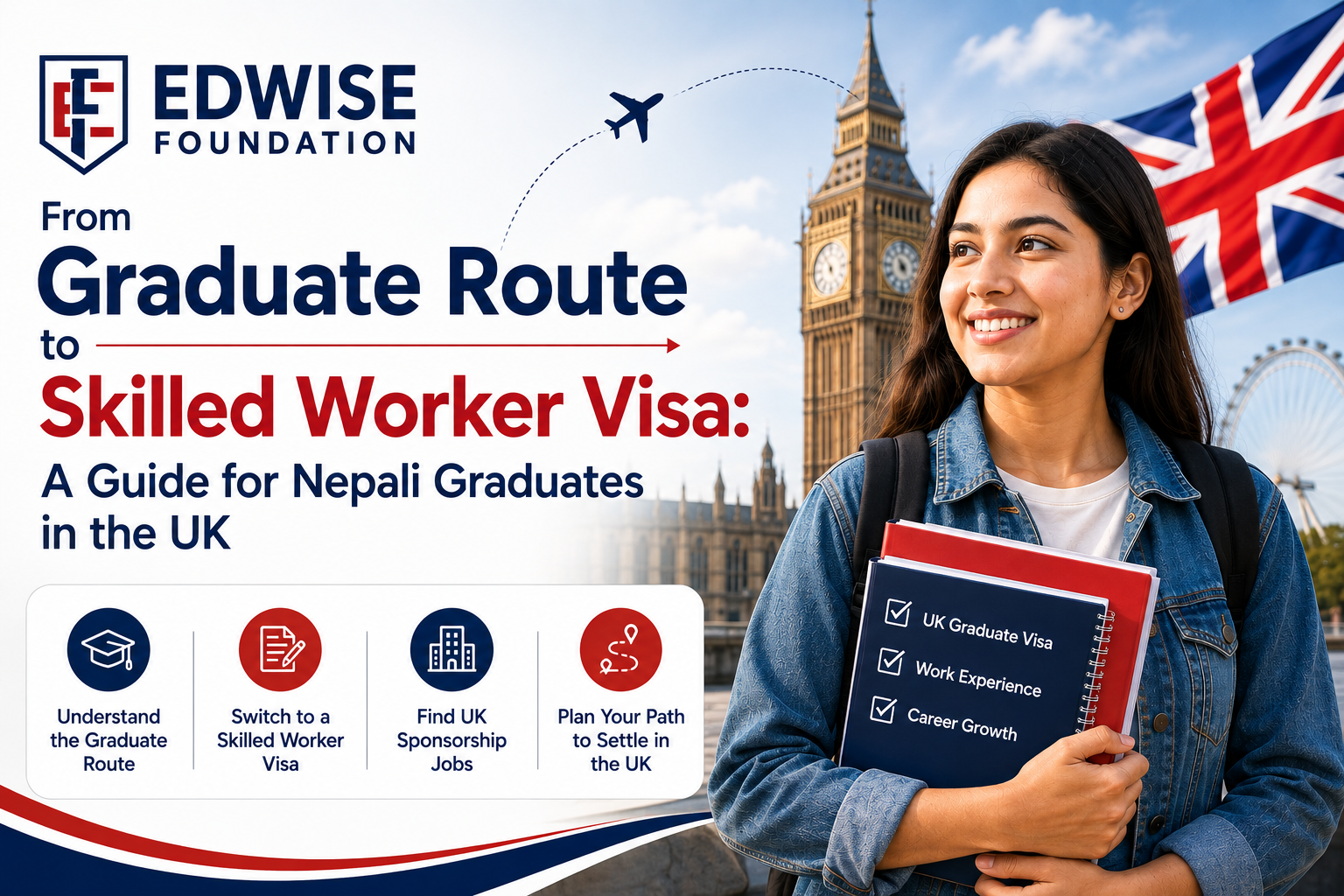
The Graduate Route lets eligible UK graduates work without sponsorship for a limited time, but it cannot be extended. To stay longer, many Nepali graduates switch to a Skilled Worker visa — which requires a job offer from a Home Office-approved sponsor, a Certificate of Sponsorship, and a salary and role that meet the rules in force when you apply. The switch is not automatic: having a Graduate visa does not guarantee a Skilled Worker visa. Unlike the Graduate Route, the Skilled Worker route can lead to settlement (ILR).
For many Nepali students, studying in the UK is not only an opportunity to earn an internationally recognised qualification, but also to gain valuable international work experience after graduation. A common question is: “What happens after my UK Graduate visa ends?”
For graduates who want to continue their professional career in the UK, one possible next step is to switch from the Graduate Route to a Skilled Worker visa, provided they meet the eligibility requirements. The Graduate Route allows eligible graduates to work or look for work without employer sponsorship for a limited period — but the Graduate visa cannot be extended. Graduates who want to remain longer will therefore need to qualify for another immigration route.
This guide explains how Nepali graduates can potentially move from a UK Graduate visa to a Skilled Worker visa, what sponsorship involves, and how students can prepare for this transition.
What is the UK Graduate Route?
The Graduate Route, commonly known as the Graduate visa, allows eligible international students who successfully complete an eligible UK qualification to remain in the UK after their studies. The length of the Graduate visa depends on the qualification and when the application is made:
- Complete an eligible Bachelor’s, Master’s or other qualifying course and apply on or before 31 December 2026 — the Graduate visa normally lasts 2 years.
- Apply on or after 1 January 2027 — the Graduate visa for these qualifications normally lasts 18 months.
- PhD or other doctoral graduates normally receive 3 years, including under the rules applying from January 2027.
The Graduate Route generally allows eligible graduates to work in most jobs, look for work, change employers, be self-employed (subject to immigration conditions), and gain professional experience in the UK. Its biggest advantage is that you do not need an employer to sponsor you. However, the Graduate visa is temporary and cannot be extended. For a full breakdown of eligibility and timings, see our Graduate Route guide for Nepali students.
What happens when your Graduate visa ends?
If you want to remain in the UK after your Graduate visa expires, you will need to qualify for another immigration route. For graduates who secure an eligible job with an approved UK employer, one potential option is the Skilled Worker visa.
Moving from the Graduate Route to the Skilled Worker route is not automatic. You must independently satisfy the Skilled Worker visa requirements in place when you apply.
What is the UK Skilled Worker visa?
The Skilled Worker visa allows eligible overseas workers to work in the UK for an approved employer in a qualifying job. Unlike the Graduate Route, the Skilled Worker route is based on employer sponsorship. You will generally need:
- A job offer from a Home Office-approved UK employer.
- A valid Certificate of Sponsorship (CoS) from your employer.
- A job that meets the applicable occupation and skill requirements.
- A salary that meets the relevant minimum salary and going-rate requirements for your circumstances.
- To satisfy the applicable English language requirement.
- To meet the other immigration requirements in force when you apply.
The exact requirements can vary according to your occupation, salary, circumstances and the Immigration Rules in effect at the time of application.
Graduate visa vs Skilled Worker visa
| Feature | Graduate Route | Skilled Worker visa |
|---|---|---|
| Employer sponsorship | Not required | Required |
| Job offer required | No | Yes |
| Employer must be an approved sponsor | No | Yes |
| Length of stay | 2 years (eligible non-doctoral, applied by 31 Dec 2026); 18 months from 1 Jan 2027; 3 years for PhD/doctoral | Depends on sponsorship and visa grant |
| Changing employers | Generally yes | Yes, but you may need to update your visa before starting a new sponsored job |
| Direct route to settlement | No | Can lead to settlement if all requirements are met |
| Certificate of Sponsorship required | No | Yes |
Can you switch from a Graduate visa to a Skilled Worker visa?
Yes, in many cases. A person in the UK on a Graduate visa may be able to apply to switch to a Skilled Worker visa from within the UK if they meet the relevant requirements.
Having a Graduate visa does not, however, guarantee that you will qualify for a Skilled Worker visa. You will need an eligible job with an approved sponsor and must meet the Skilled Worker requirements applicable at the time of your application.
How to move from the Graduate Route to a Skilled Worker visa
Step 1: Successfully complete your UK course
The first stage is successfully completing an eligible UK qualification and satisfying the requirements for the Graduate Route. Your education provider must report your successful course completion to the Home Office before you can qualify for the Graduate visa.
Step 2: Apply for the Graduate visa
If you are eligible, you must apply before your Student visa expires. Once your Graduate visa is granted, you can use this period to work, gain experience and explore longer-term career opportunities without initially requiring employer sponsorship.
Step 3: Build relevant UK work experience
Use your time on the Graduate Route strategically. Depending on your field, focus on developing job-specific skills, building relevant experience, understanding UK workplace practices, strengthening professional communication, networking, using university careers services, and building a strong UK-focused CV and LinkedIn profile.
Step 4: Identify employers that can sponsor Skilled Workers
Not every UK employer can sponsor international workers. For the Skilled Worker route, the employer generally needs to be approved by the Home Office. The UK Government maintains an official Register of Licensed Sponsors. Appearing on the register does not mean an employer will sponsor every vacancy or applicant.
Step 5: Secure an eligible job offer
Your employer must offer you a position that meets the Skilled Worker requirements applicable to your circumstances. Eligibility can depend on the occupation code, whether the occupation is eligible for sponsorship, salary, applicable going rate, any relevant salary provisions, and the immigration rules in effect when you apply.
Step 6: Obtain a Certificate of Sponsorship
If the employer decides to sponsor you, it will assign you a Certificate of Sponsorship (CoS) — an electronic sponsorship record containing information about your employer and the job offered.
Step 7: Apply for the Skilled Worker visa
Once you have an eligible sponsored job and Certificate of Sponsorship, you can apply for the Skilled Worker visa if you satisfy the remaining requirements. Apply while you still hold valid immigration permission.
Our UK advisors help Nepali students choose courses and universities with employability and post-study routes in mind.
Book a free consultationWhen should you start looking for UK visa sponsorship?
It is sensible not to wait until the final months of your Graduate visa before thinking about sponsorship. Starting early gives you more time to:
- Gain relevant professional experience.
- Research employers with sponsor licences.
- Understand which roles in your field may qualify for sponsorship.
- Build professional relationships.
- Improve your CV and interview skills.
- Apply for graduate schemes and skilled positions.
- Discuss future opportunities with your employer where appropriate.
A Graduate visa gives you flexibility, but the time available is limited. Career planning should ideally begin while you are still studying and continue throughout your Graduate Route period.
Which jobs can qualify for Skilled Worker sponsorship?
There is no simple rule that says a particular degree automatically leads to UK visa sponsorship. Eligibility depends on the specific job, occupation code, employer, salary and immigration requirements. International graduates may find sponsored opportunities across a range of professional fields, potentially including:
- Information Technology and Software Development
- Artificial Intelligence and Machine Learning
- Cyber Security
- Data and Analytics
- Engineering
- Healthcare and certain health professions
- Finance and Accounting
- Architecture
- Education
- Construction and related professional occupations
- Business and professional services
However, studying in one of these fields does not guarantee sponsorship. Check whether the particular role is eligible and whether the employer is willing and licensed to sponsor Skilled Workers.
Does every UK employer offer visa sponsorship?
No. Some UK employers hold sponsor licences and actively recruit international workers. Others may hold a licence but sponsor only selected positions. Many employers do not sponsor workers at all. When looking at a role:
- Read the job advertisement carefully.
- Research the employer.
- Check whether the organisation appears on the official sponsor register.
- Look for information about visa sponsorship in the vacancy.
- Ask about sponsorship at an appropriate stage of the recruitment process if the position is unclear.
Do not assume a company will provide sponsorship simply because it appears on the government’s sponsor list.
Skilled Worker visa salary requirements
Salary is an important part of Skilled Worker eligibility. However, there is not one salary figure that applies to every applicant and every job. The amount you need to earn can depend on factors such as:
- Your occupation code.
- The going rate for your occupation.
- Whether special salary provisions apply to your circumstances.
- Whether your job is in healthcare or education.
- Whether any relevant immigration salary provisions or discounts apply.
- The Immigration Rules in force when you apply.
Salary thresholds and occupation requirements can change. Always check the latest official UK Government guidance rather than relying on an old salary figure found online.
Can you bring dependants on a Skilled Worker visa?
The Skilled Worker route can allow eligible partners and children to apply as dependants, subject to the Immigration Rules and any restrictions that apply to the applicant’s occupation or circumstances.
If you switch from another visa to a Skilled Worker visa, your family members’ visas do not automatically switch with yours — they may need to make their own applications. Because dependant rules can change and may differ by occupation and circumstances, always check the latest official requirements before making family plans.
Does the Graduate Route count towards Skilled Worker settlement?
The Graduate Route itself is not a direct route to settlement under the Skilled Worker five-year route. The Skilled Worker route, however, can lead to Indefinite Leave to Remain (ILR) if you meet the qualifying residence and other settlement requirements applicable when you apply.
Career tips for Nepali students planning to work in the UK
- Research career prospects before choosing your course.
- Look for degrees offering internships, placements or strong employer engagement.
- Use your university’s careers service from the beginning of your studies.
- Develop professional communication and interview skills.
- Build a UK-focused CV.
- Gain relevant work, internship or placement experience where permitted.
- Attend university career fairs and employer networking events.
- Research licensed sponsors within your industry.
- Apply for graduate schemes early, as some recruitment cycles begin well before graduation.
- Keep track of your visa expiry date and changes to UK immigration rules.
Most importantly, do not choose a UK degree solely because you believe it will guarantee a Skilled Worker visa. Course choice should take into account academic suitability, career objectives, employability, cost and your overall long-term plans.
Common mistakes to avoid
- Waiting until the Graduate visa is about to expire before exploring sponsorship.
- Assuming a Graduate visa automatically leads to a Skilled Worker visa.
- Assuming every employer can or will provide sponsorship.
- Applying only to large companies and overlooking other licensed employers.
- Focusing on job titles without checking the relevant occupation requirements.
- Relying on outdated salary thresholds or immigration information.
- Assuming that studying a particular subject guarantees sponsorship.
- Ignoring changes to UK immigration rules.
Plan your UK study and career journey carefully
For Nepali students considering the UK, it helps to understand the complete journey — from choosing the right university and course to graduate employment opportunities and the immigration routes that may be available after study. The Graduate Route can provide valuable time to gain UK work experience, while the Skilled Worker visa may offer a longer-term pathway for graduates who secure an eligible sponsored position.
Neither route guarantees permanent employment or settlement, and UK immigration policies can change. As Nepal’s first AIRC-certified and ICEF-screened education consultancy, Edwise Foundation has guided Nepali students since 2005 to make decisions based on academic goals, finances, career prospects and the latest official requirements. With a 96% acceptance rate and 7,000+ students placed, we help you plan the whole journey. For the full picture of studying in the UK, requirements and intakes, see our complete guide to study in the UK from Nepal.
Last updated August 2026. UK immigration rules and eligibility requirements can change. This article provides general information based on the rules available at the time of publication and does not constitute immigration or legal advice. Always check the latest GOV.UK guidance or seek advice from a suitably qualified immigration professional before making an application.
Book a free consultation with our UK team for advice on courses, employability and your long-term options.
Book a free consultationFrequently asked questions