Step by Step Process to Study in Canada in 2026
- Posted by Edwise Foundation
- Categories Study in Canada
- Date April 4, 2026
🎯 Quick Answer
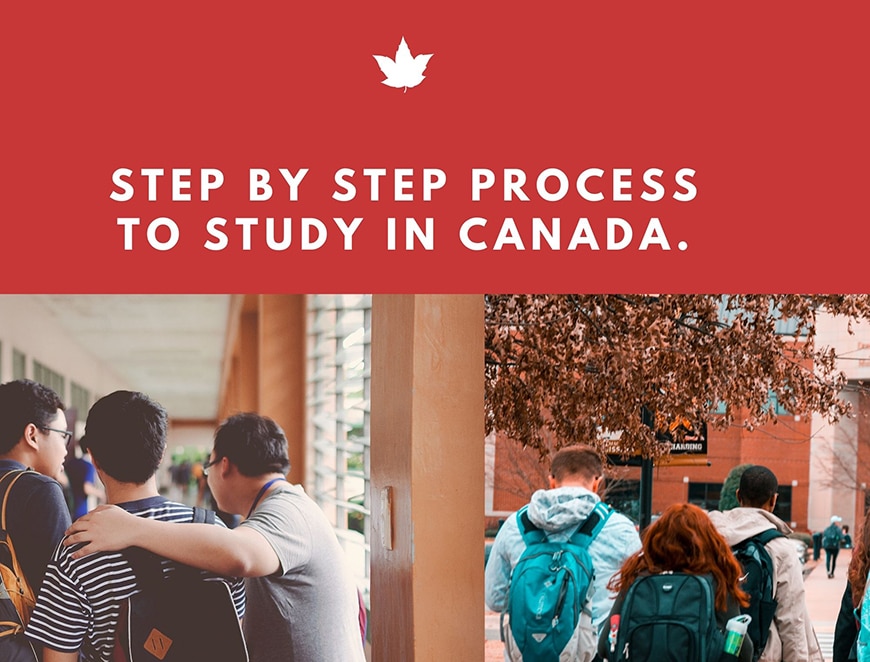
To study in Canada from Nepal, you must: (1) research programs and eligibility, (2) pass an English proficiency test (IELTS/TOEFL/PTE), (3) apply to a Designated Learning Institution (DLI), (4) receive a Letter of Acceptance, (5) arrange finances (minimum CAD 22,895 for a single student as of 2025), (6) obtain a Provincial Attestation Letter (PAL) if required, and (7) apply for a study permit through IRCC. Study permit processing typically takes 4–12 weeks. The visa approval rate from Nepal has risen to 57% in 2025 and is projected to reach 65% in 2026.
📋 Table of Contents
- Why Study in Canada? Key Facts for 2026
- Step 1 — Research & Initial Counselling
- Step 2 — English Proficiency Test
- Step 3 — Apply to Universities / Colleges
- Step 4 — Receive Your Offer Letter
- Step 5 — Financial Arrangement & Fee Payment
- Step 6 — Get Your PAL / TAL (If Required)
- Step 7 — Apply for a Study Permit (Student Visa)
- Step 8 — Post-Visa: Arrival & First Days
- Post-Graduation Work Permit (PGWP) Explained
- 2026 International Student Cap — What You Must Know
- Frequently Asked Questions
Why Study in Canada? Key Facts for 2026
Canada is consistently ranked among the world's top study destinations — and for good reason. It offers globally recognised degrees, post-study work rights, and a clear pathway to permanent residency. For Nepali students specifically, Canada has become the first-choice destination over the past five years.
The Complete Step-by-Step Process
Research & Initial Counselling
Before anything else, gather accurate information about Canada's education system, admission requirements, visa rules, tuition costs, and post-study opportunities. This stage prevents costly mistakes later.
What to research:
- Provinces and cities (Toronto, Vancouver, Calgary, Halifax)
- Types of institutions: universities vs. colleges vs. polytechnics
- Program duration and tuition range (CAD 15,000–40,000/year for undergraduate)
- Whether your program and province require a Provincial Attestation Letter (PAL/TAL)
- Study permit cap exemptions (Master's & PhD students are exempt from January 2026)
- PGWP eligibility for your chosen program
Appear for an English Proficiency Test
All Canadian institutions require proof of English proficiency. This step should be completed well before your intended application deadline — ideally 6–9 months before your intake date.
| Test | Typical Minimum Score | Widely Accepted? |
|---|---|---|
| IELTS Academic | 6.0–6.5 (no band below 6.0) | ✅ Yes — most common |
| TOEFL iBT | 80–88 (no section below 20) | ✅ Yes |
| PTE Academic | 58–65 (no section below 50) | ✅ Yes |
| Duolingo | 115–125 | ⚠️ Some institutions only |
Edwise Foundation offers preparation classes for IELTS, TOEFL, and PTE in Kathmandu. Scoring above the minimum significantly improves your chances of both admission and visa approval.
Apply to Universities or Colleges
Once you have your test scores and confirmed your eligibility, apply to your shortlisted DLI(s). Choosing the right program and institution is a critical decision — seek expert guidance if needed.
Typical documents required for admission:
- Academic transcripts (official, translated)
- English proficiency score
- Valid passport copy
- Statement of Purpose (SoP) — for graduate programs
- Work experience certificate — for graduate programs
- Letters of Recommendation (LORs)
- Application fee payment
- Other test scores (GRE/GMAT, if needed)
Common reasons for application rejection:
- Not meeting minimum academic requirements
- Incomplete or incorrectly submitted applications
- Applying after the deadline
- Poor program-profile match
- Highly competitive applicant pool
Receive Your Offer Letter
If your application is successful, the institution issues an Offer Letter (also called a Conditional Acceptance Letter). This document includes your name, program of study, program start date, tuition fees, deposit amount, and the institution's DLI code.
Processing time varies by institution — typically 3–8 weeks after submission. Pay close attention to any conditions listed (e.g., minimum English score to be verified, fee deposit deadline).
Review the offer letter carefully before paying the deposit. Ensure the institution is a DLI and that your program is PGWP-eligible if that matters to your post-study plans.
Financial Arrangement & Fee Payment
After receiving your offer letter, pay the tuition deposit as instructed. This triggers the issuance of your Letter of Acceptance (LoA) — which is the key document required to apply for your study permit.
Proof of funds required (as of November 2025):
| Applicant | Amount Required (CAD) |
|---|---|
| Single student | CAD 22,895 |
| Spouse / common-law partner | + CAD 4,580 |
| Each dependent child | + CAD 3,135 |
Acceptable financial evidence includes bank statements, property valuation certificates, salary/income certificates, tax clearance, and loan approval letters. All documents must clearly show sufficient liquid funds to cover tuition plus living costs for your full program duration.
Get Your Provincial Attestation Letter (PAL / TAL)
A Provincial Attestation Letter (PAL) or Territorial Attestation Letter (TAL) confirms that you have been allocated one of the available international student spaces under the provincial quota of Canada's federal study permit cap.
Most international students applying for post-secondary undergraduate or diploma programs at a Canadian DLI must include a PAL/TAL with their study permit application.
Who is EXEMPT from the PAL/TAL requirement?
- Master's and PhD students at public DLIs (exempt from January 1, 2026)
- Primary and secondary school students
- Students in certain short-term programs (less than 6 months)
- Some continuing-education and professional development students
Apply for a Canada Study Permit (Student Visa)
A Canadian study permit is not a visa — it is an official authorization to study in Canada. As a Nepali citizen, you also need a Temporary Resident Visa (TRV) to enter Canada, which is usually processed simultaneously with your study permit application.
Submit your application online through the IRCC portal (strongly recommended over paper applications). Processing time for Nepali applicants is typically 4–12 weeks in 2026.
Complete document checklist:
- Valid passport (6+ months validity)
- Letter of Acceptance (LoA) from a DLI
- Academic transcripts (official)
- English proficiency results
- Completed IRCC application forms
- Passport-size photographs
- Police Clearance Certificate
- Letter of Explanation (Statement of Purpose)
- Financial documents (bank statements, property valuation, income proof)
- PAL / TAL (if applicable to your program)
- Biometrics (fingerprints & photo)
- Medical examination (if required)
- Relationship verification certificate (if dependents are accompanying)
Visa Decision, Arrival & First Days in Canada
IRCC reviews your application and may request additional documents or an interview. If approved, you receive a Letter of Introduction (which serves as your study permit until you arrive) and, if applicable, a TRV stamp in your passport.
Upon arrival at a Canadian port of entry:
- Present your passport, Letter of Introduction, LoA, and supporting documents
- A border services officer will issue your actual Study Permit
- Double-check the study permit for accuracy (program, institution, expiry date)
Before you travel, make sure you have:
- Confirmed accommodation (on-campus or off-campus)
- Booked flights at least 4–6 weeks before program start
- Arranged health insurance (mandatory in most provinces)
- Completed a pre-departure orientation
Post-Graduation Work Permit (PGWP) — What You Need to Know
The Post-Graduation Work Permit (PGWP) is one of the biggest advantages of studying in Canada. It allows eligible graduates to stay and work in Canada for up to 3 years after completing their studies — a direct stepping stone to Permanent Residency (PR) through Express Entry or Provincial Nominee Programs (PNP).
| Program Duration | PGWP Duration |
|---|---|
| 8 months – 2 years | Same as program length |
| 2+ years | 3 years (maximum) |
| Master's / PhD (public DLI) | Up to 3 years, regardless of field of study |
Key PGWP rules for 2026:
- You must have studied at a PGWP-eligible DLI
- Program must be at least 8 months long
- Submit your PGWP application within 180 days of receiving proof of program completion
- Master's and PhD graduates at public DLIs qualify regardless of field of study
- Spouses of master's/PhD students are eligible for open spousal work permits
2026 International Student Cap — What Nepali Students Must Know
Canada has introduced a national cap on new study permits to manage rapid growth in international student numbers. This affects undergraduate and diploma-level applicants most significantly.
| Year | Study Permit Cap (New Permits) | PAL/TAL Required? |
|---|---|---|
| 2026 | ~155,000 new study permits | Yes (for most undergrad/diploma) |
| 2027 | ~150,000 new study permits | Yes (for most undergrad/diploma) |
| 2028 | ~150,000 new study permits | Yes (for most undergrad/diploma) |
Practical advice given the cap:
- Apply early — PAL quotas are distributed on a first-come, first-served basis by province
- Consider graduate programs if you qualify — they face fewer restrictions
- Work with an experienced counsellor to identify provinces with higher PAL availability
- Have complete documentation ready to submit immediately after receiving your LoA and PAL
Frequently Asked Questions (FAQ)
❓ How long does it take to get a Canada study permit from Nepal?
Standard processing time is 4–12 weeks from the date of complete application submission. PhD applicants may qualify for priority processing within 14 days. Apply at least 3 months before your program start date to allow buffer time.
❓ What is the minimum IELTS score required to study in Canada?
Most Canadian institutions require a minimum IELTS Academic score of 6.0 to 6.5, with no individual band below 6.0. Graduate programs and competitive courses often require 6.5 or higher. Check your specific institution's requirements.
❓ How much money do I need to show for a Canada study permit from Nepal?
As of November 2025, a single student must show at least CAD 22,895 in proof of funds, plus full first-year tuition. Add CAD 4,580 per accompanying spouse and CAD 3,135 per dependent child.
❓ Can I work while studying in Canada?
Yes. International students with a valid study permit can work up to 24 hours per week off-campus during academic sessions and full-time during scheduled breaks. No separate work permit is needed.
❓ Do I need a PAL/TAL to apply for a study permit?
Most undergraduate and diploma-level applicants need a PAL/TAL. Master's and PhD students at public DLIs are exempt from this requirement from January 1, 2026. Your institution arranges the PAL on your behalf after you pay the tuition deposit.
❓ Is SDS (Student Direct Stream) still available from Nepal?
No. The Student Direct Stream (SDS) was discontinued on November 8, 2024. All Nepali applicants now use the standard non-SDS study permit process.
❓ What is the study permit approval rate from Nepal in 2026?
The approval rate rose to 57% in 2025 (January–August) from around 41% in 2024. It is projected to reach 65% in 2026 for well-prepared applicants with complete and accurate documentation.
🍁 Ready to Start Your Canada Journey?
Edwise Foundation is Nepal's first AIRC-certified consultancy, guiding 6,000+ students successfully since 2005. Get personalised guidance from application to visa — at no cost to you.
Book a FREE Consultation →Tag:Course
Edwise Foundation is your dedicated abroad education partner. We are more than an education consultancy; we're your route to international education. We have a long history of guiding ambitious young minds. Our extensive experience in counseling abroad studies and smooth application processing makes it easier for students to achieve their academic goals.
f i y t n
You may also like
Visa Success Rate for Canada From Nepal in 2025