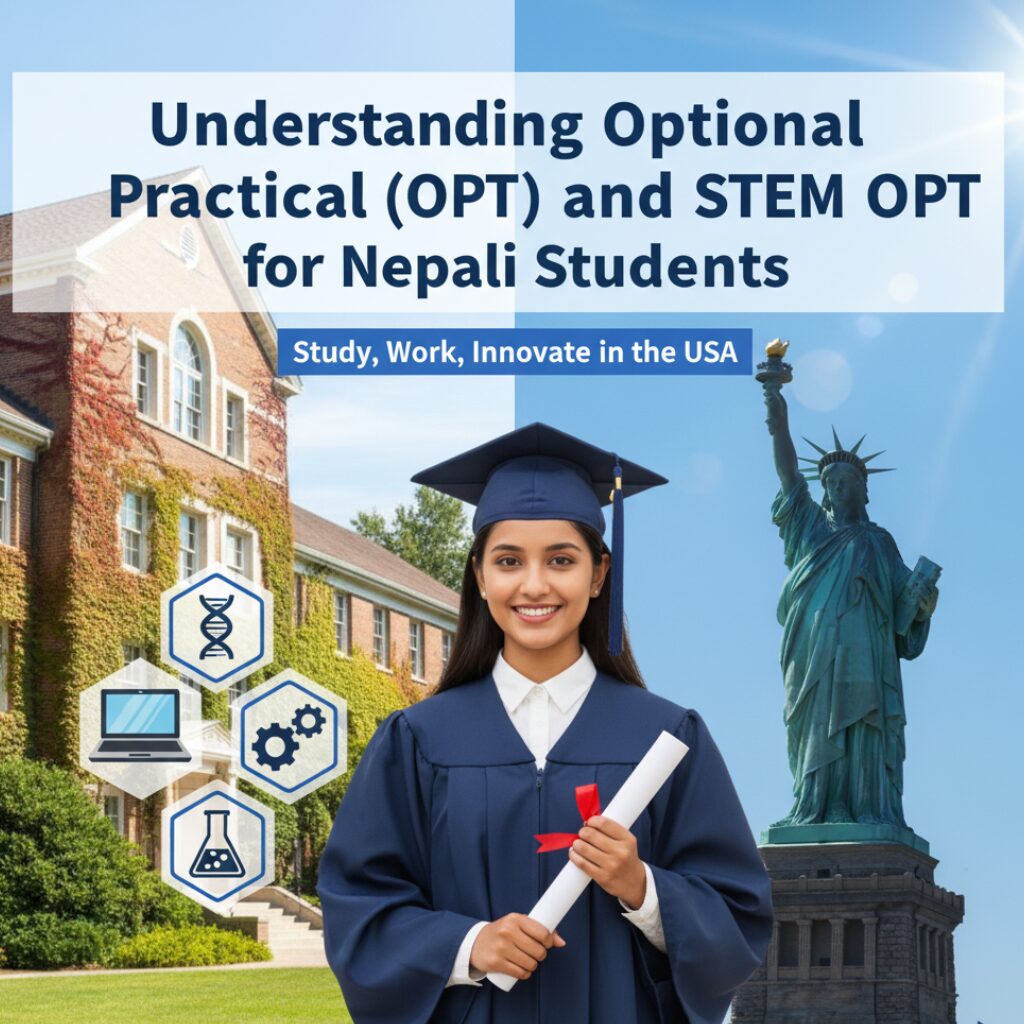
Understanding Optional Practical Training (OPT) and STEM OPT for Nepali Students
Last updated: 19 October 2026
STEM stands for Science, Technology, Engineering and Mathematics. OPT stands for Optional Practical Training. It is US work permission that lets F-1 students work in a job related to their field of study, usually for 12 months after graduation. Students who graduate in an approved STEM field can apply for a 24-month STEM OPT extension, for up to 3 years of US work experience in total. For Nepali students, choosing a STEM-designated course is one of the biggest decisions affecting your career after study.
For many Nepali students, studying in the USA is about more than a degree. It is also about the chance to gain real US work experience afterwards. That chance comes through OPT and STEM OPT. This guide explains what the terms mean in simple language, how long you can work, how to apply, and what the 2026 changes could mean for you.
STEM and OPT meaning: what do the terms stand for?
| Term | Full form | What it means |
|---|---|---|
| STEM | Science, Technology, Engineering, Mathematics | Subjects based on science, technology, engineering and maths |
| OPT | Optional Practical Training | Permission to work in a job related to your studies |
| STEM OPT | STEM Optional Practical Training extension | An extra 24 months of work permission for STEM graduates |
STEM meaning with examples: Computer Science and Physics are Science and Technology subjects. Civil Engineering is Engineering. Statistics and Data Science fall under Mathematics. In the USA, degrees in these areas are called “STEM degrees”, and they qualify for longer work permission after graduation.
In Nepal’s Class 9–10 (SEE), “Opt. I” and “Opt. II” are your two optional subjects, such as Optional Mathematics or Computer Science. They are not related to US OPT. They do matter later, though: choosing Optional Maths or Computer now makes it easier to study a STEM degree abroad.
What is OPT for F-1 students?
OPT is temporary work permission for international students on an F-1 visa. Your job must be directly related to your major. You get up to 12 months of OPT at each higher degree level, for example once after your Bachelor’s and again after your Master’s.
| Type | When | Hours |
|---|---|---|
| Pre-completion OPT | While still studying | Up to 20 hrs/week in term; full-time in breaks |
| Post-completion OPT | After finishing your degree | Part-time or full-time |
Any pre-completion OPT you use is deducted from your 12 months. That is why most Nepali students save all of it for post-completion OPT.
STEM OPT extension: who qualifies?
If your degree is on the US Department of Homeland Security’s STEM Designated Degree Program List, you can apply for a 24-month extension after your first 12 months of OPT. To qualify, you must:
- Hold a degree whose CIP code is on the STEM list (check the code on your I-20)
- Work for an employer enrolled in E-Verify
- Complete a training plan (Form I-983) with your employer
- Work at least 20 hours a week in a role related to your STEM degree
| Usually STEM (up to 3 years) | Usually non-STEM (12 months) |
|---|---|
| Computer Science, IT, Cybersecurity | General Business, Management |
| Engineering (Civil, Mechanical, Electrical) | Psychology, Sociology |
| Data Science, Statistics, Mathematics | Arts, Humanities, Education |
| Biological and Physical Sciences | Political Science, Communications |
| Business Analytics, some Economics and Finance tracks | Hospitality, Tourism |
The program name alone does not decide this. A “Finance” or “MBA” program can be STEM-designated if its CIP code is on the list. Always confirm with the university before you accept your offer.
How to apply for OPT: timeline and fees
- Step 1: Get your DSO’s recommendation. Your university’s international office (DSO) recommends OPT in SEVIS and issues a new I-20.
- Step 2: File Form I-765 with USCIS. You can file from 90 days before to 60 days after your program end date, and within 30 days of the DSO recommendation.
- Step 3: Attend biometrics. USCIS now takes your EAD card photo at an in-person biometrics appointment.
- Step 4: Start work only after approval. You can work once you receive your EAD card and the start date has arrived.
| Form I-765 filing | Fee (US$) |
|---|---|
| Online filing | 470 |
| Paper filing | 520 |
For STEM OPT, file up to 90 days before your current OPT card expires. If you file on time, you can usually keep working for up to 180 days while the extension is pending.
Our US counsellors help you shortlist STEM-designated programs that match your profile and career goals.
Book a free consultation2026 update: proposed new OPT fees
On 8 October 2026, the US Department of Homeland Security published a proposed rule that would add large new fees to OPT:
| Proposed fee | Amount | Status |
|---|---|---|
| First OPT recommendation (pre- or post-completion) | US$70,000 | Proposed, not in effect |
| Further OPT, including the STEM OPT extension | US$30,000 | Proposed, not in effect |
The fee would be charged to universities. They could pass it on to students or employers. Under the proposal, it would apply only to OPT recommendations made after a final rule takes effect, and students already on OPT would not pay it. However, a student already on OPT who later applies for STEM OPT could be charged.
Nothing has changed yet. The rule is open for public comments, may be changed or challenged in court, and would take effect only after a final rule is published. If you are planning a US degree, ask universities how they would handle the fee. We will update this guide when DHS publishes a decision.
OPT rules: do’s and don’ts
- Do report your employer and address to your DSO, or in the SEVP portal, within 10 days of any change.
- Do keep offer letters, job descriptions and pay slips that show how your job relates to your degree.
- Do apply early. Late applications are a common reason for losing OPT.
- Don’t exceed 90 days of unemployment on OPT, or 150 days in total if you get STEM OPT.
- Don’t work for a STEM OPT employer that is not enrolled in E-Verify.
- Don’t take a job that is unrelated to your field of study.
What comes after OPT?
- H-1B work visa: if an employer sponsors you and you are selected in the H-1B lottery. A “cap-gap” extension can keep your status and work permission valid while a timely H-1B change of status is pending.
- Further study: a Master’s or PhD at a higher level gives you a new period of OPT.
- Return to Nepal or move elsewhere: US work experience strengthens your CV for employers in Nepal and around the world.
STEM OPT gives you up to three H-1B lottery chances instead of one, which is a big reason STEM degrees are popular with Nepali students.
STEM OPT planning tips for Nepali students
- Check that a program is STEM-designated (by its CIP code) before you apply, not after you arrive.
- Build experience during your degree through internships (CPT) and campus jobs, so you can find an OPT job quickly.
- Budget for at least 2–3 months without income after graduation while you job hunt.
- Follow the 2026 OPT fee proposal and ask universities about their plans.
How Edwise Foundation helps
Your OPT options are decided the day you choose your course. Edwise Foundation has guided Nepali students to the USA since 2005. We are AIRC-certified, partner with 150+ universities and have placed 7,000+ students abroad. Our counsellors, many of whom studied abroad themselves, help you shortlist STEM-designated programs, check CIP codes and plan your career path before you apply, as part of our study in the USA from Nepal service.
Book a free counselling session at our New Plaza, Kathmandu office or online.
Book a free consultationFrequently asked questions
References
This article is for general information only and is not immigration or legal advice. Always confirm OPT rules with your university’s DSO and the latest USCIS guidance.