
South Korea has become one of the fastest-growing study destinations for Nepali students and for good reason. With world-ranked universities, tuition fees far lower than the USA or UK, a booming tech economy, and a clear pathway from student visa to work visa, Study in South Korea from Nepal offers something most Western countries no longer can: genuine value for your money and your future.
But the process of actually getting there choosing the right university, meeting visa requirements, passing the MOFA notarization process in Nepal, and avoiding the most common reasons for visa rejection is where most students get stuck.
This guide covers everything in detail, including specifics that most articles skip.
| Quick Answer: Total yearly cost for a Nepali student in South Korea: NPR 8–18 lakhs depending on city and university. Part-time work (up to 25 hrs/week) can cover NPR 30,000–60,000/month of that. Visa processing takes 2–6 weeks after university acceptance. |
Why South Korea? How It Compares for Nepali Students
Nepal sends thousands of students abroad each year. Here is how South Korea stacks up against the most common alternatives:
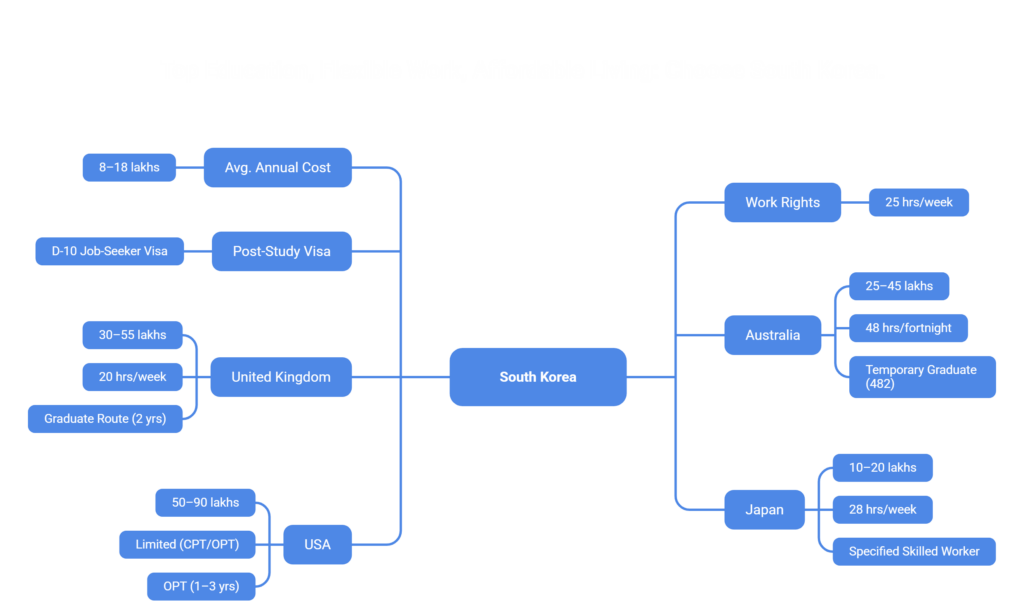
Korea stands out for affordability and accessibility especially for students who do not have IELTS scores or high academic grades, since the D-4 language route provides an alternative entry pathway.
South Korea Education System: What Nepali Students Need to Know
They follows a structured academic system aligned with international standards:
| Program | Duration | Key Intakes |
| Korean Language (D-4) | 6 months–2 years | March, July, September |
| Bachelor’s Degree (D-2) | 4 years | March (Spring), September (Fall) |
| Master’s Degree (D-2) | 2 years | March, September |
| PhD (D-2) | 3–4 years | March, September |
| Important: Spring intake (March) applications open August–November. Fall intake (September) applications open February–May. Missing these windows means waiting 6 months, so plan at least 8–10 months ahead. |
Top Universities Nepali Students Apply To
These are the universities most frequently attended by Nepali students, with a range of entry requirements to match different academic profiles:
| University | Location | Known For | Min. CGPA |
| Seoul National University (SNU) | Seoul | Research, Engineering, Medicine | 3.5+ |
| Korea University (고려대) | Seoul | Business, Law, Liberal Arts | 3.0+ |
| Yonsei University (연세대) | Seoul | Medicine, International Studies | 3.0+ |
| Sungkyunkwan University (SKKU) | Seoul/Suwon | Samsung-affiliated, Engineering | 2.8+ |
| Hanyang University | Seoul/Ansan | Engineering, Architecture | 2.5+ |
| Pusan National University | Busan | Affordable, Engineering | 2.5+ |
| Keimyung University | Daegu | Popular with Nepali students | 2.2+ |
| Woosong University | Daejeon | Hospitality, Culinary Arts | 2.0+ |
SKY universities (SNU, Korea, Yonsei) are highly competitive. For most Nepali students with 2.5–3.0 CGPA, mid-tier universities like Hanyang, SKKU, Keimyung, or Woosong are more realistic and still provide strong career outcomes.
Student Visa Types: D-2 vs D-4 Explained
D-2 Visa: Degree Programs
The D-2 visa is for students enrolled in formal degree programs: Bachelor’s, Master’s, or PhD.
- English requirement: IELTS minimum 5.5 for English-medium programs (some universities accept 5.0 with conditional acceptance)
- Korean requirement: TOPIK Level 3–4 for Korean-medium programs
- Minimum CGPA: 2.0–3.2 depending on university and program
- Work rights: No work allowed during first semester. After first semester: up to 25 hours per week. During holidays (winter/summer break): full-time work allowed
D-4 Visa: Language Programs
The D-4 visa is for students enrolling in Korean language programs at university language institutes. This is the most common entry route for Nepali students who do not yet have IELTS or want to learn Korean before a degree.
- Language test: No IELTS required, this is the biggest advantage
- Work rights: After completing first semester (approx. 3 months): up to 25 hours/week
- Upgrade path: Students can switch from D-4 to D-2 after completing TOPIK Level 3+ and meeting university admission requirements
- Accommodation note: Dormitory stay is often required or strongly recommended in the first semester by language institutes
| Visa Refusal Warning: The most common reasons for D-4/D-2 visa rejection for Nepali applicants planning to Study in South Korea from Nepal include insufficient bank balance documentation, documents not notarized through MOFA, inconsistent financial records, and incomplete tuberculosis test results. See the documents section below. |
Language Requirements: IELTS vs TOPIK
| Requirement | For English Programs | For Korean Programs |
| Test needed | IELTS Academic (min. 5.5) | TOPIK (Test of Proficiency in Korean) |
| Minimum level | Band 5.5–6.0 | TOPIK Level 3 (most universities) |
| Cost in Nepal | NPR 22,000–24,000 | NPR (4,000–6,000 per sitting |
| Where to take it | British Council, IDP Kathmandu | Korean Cultural Center, Kathmandu |
| Validity | 2 years | Indefinite (no expiry) |
| Can you skip it? | Only via D-4 route first | Not required for English programs |
TOPIK is offered 4–6 times per year in Nepal. Registrations typically open 6–8 weeks before the exam. TOPIK Level 3 is the standard minimum for most degree programs taught in Korean. Some universities accept Level 2 for conditional admission.
Study in South Korea from Nepal: Document Required
This is the section most articles ignore. South Korea requires MOFA (Ministry of Foreign Affairs) notarization for academic documents from Nepal. This process is done in Kathmandu and takes 7–21 working days.
Standard Document Checklist
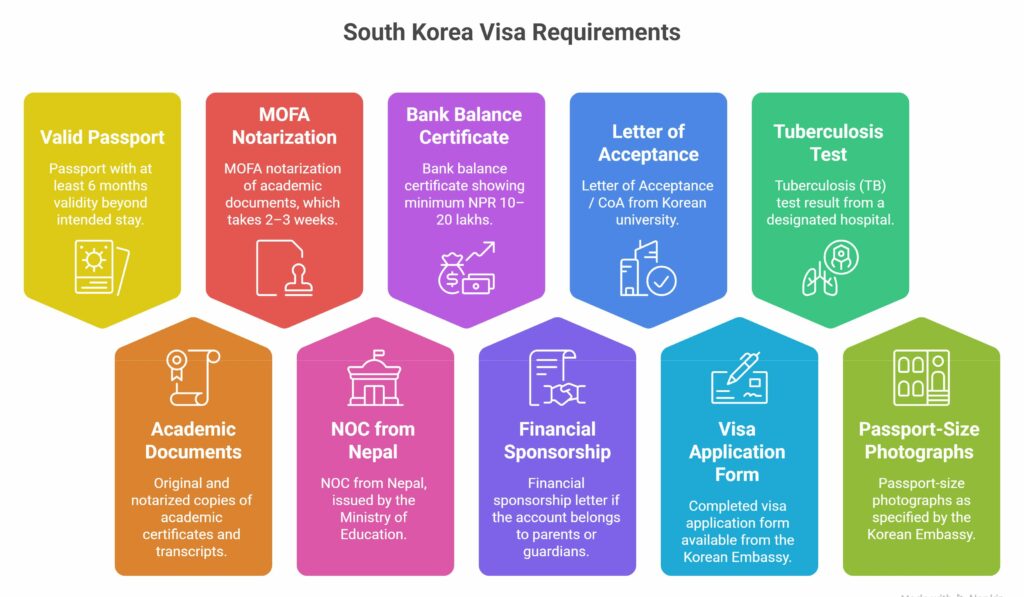
| Pro tip: Start MOFA notarization and the NOC process the moment you decide to apply do not wait for university acceptance. These two steps alone can take 4–6 weeks and are non-negotiable. |
Real Cost Breakdown for Nepali Students (2025–2026)
Tuition Fees by Program
| Program Type | Annual Tuition (NPR) | Annual Tuition (KRW) |
| Korean Language (D-4) | NPR 2–4 lakhs | KRW 2,000,000–4,000,000 |
| Bachelor’s — Humanities/Social Science | NPR 4–6 lakhs | KRW 4,000,000–6,000,000 |
| Bachelor’s — Engineering/Science | NPR 6–9 lakhs | KRW 6,000,000–9,000,000 |
| Master’s Degree | NPR 5–10 lakhs | KRW 5,000,000–10,000,000 |
| PhD (often funded) | NPR 0–5 lakhs | KRW 0–5,000,000 |
Monthly Living Costs by City
| Expense | Seoul | Busan/Daegu | Daejeon |
| Dormitory | NPR 40,000–70,000 | NPR 25,000–50,000 | NPR 20,000–45,000 |
| Goshiwon (cheapest room) | NPR 35,000–55,000 | NPR 25,000–40,000 | NPR 20,000–35,000 |
| Shared apartment | NPR 60,000–90,000 | NPR 40,000–65,000 | NPR 35,000–55,000 |
| Food (cooking at home) | NPR 20,000–30,000 | NPR 18,000–28,000 | NPR 15,000–25,000 |
| Food (eating out, mix) | NPR 35,000–55,000 | NPR 28,000–45,000 | NPR 22,000–38,000 |
| Transport (T-money card) | NPR 7,000–12,000 | NPR 5,000–9,000 | NPR 4,000–7,000 |
| Phone + internet | NPR 4,000–7,000 | NPR 4,000–7,000 | NPR 4,000–7,000 |
| Estimated total/month | NPR 80,000–140,000 | NPR 60,000–110,000 | NPR 50,000–90,000 |
| Cost-saving reality: Most Nepali students in dorms who cook regularly and start part-time work after eligibility can realistically live on NPR 60,000–80,000/month in Seoul and NPR 45,000–65,000/month in smaller cities. |
Scholarships Available for Nepali Students
1. Global Korea Scholarship (GKS): Fully Funded
The GKS is the flagship Korean government scholarship for international students. It is highly competitive but genuinely transformative for those who receive it.
- Full tuition waiver for the entire program
- Monthly living stipend: KRW 900,000 (approx. NPR 90,000)
- Return airfare (one-time)
- 1-year Korean language training before degree program
- Medical insurance coverage
- Settlement allowance on arrival
Application is either through the Korean Embassy in Kathmandu (Embassy Track) or directly through universities (University Track). Embassy track applications open around February–March each year.
2. University-Level Scholarships
Most Korean universities offer merit-based tuition waivers for international students. These are easier to obtain than GKS and can significantly reduce your costs:
- Hanyang University: 30–100% tuition waiver for international students based on grades
- Keimyung University: partial scholarships widely available for Nepali students
- Woosong University: specific programs with reduced tuition for international applicants
- Pusan National University: government-affiliated scholarships for ASEAN students
Always apply for university scholarships in your initial application most require a separate scholarship application form submitted at the same time.
Part-Time Work: What Nepali Students Actually Earn
While Studying in South Korea’s minimum wage in 2025 is KRW 10,030 per hour (approximately NPR 1,000–1,050 per hour at current rates). At 25 hours/week, that is roughly:
- Weekly earnings: KRW 250,750 (approx. NPR 25,000–27,000)
- Monthly earnings: KRW 1,003,000 (approx. NPR 100,000–108,000)
In practice, after taxes and depending on job type, most Nepali students report taking home NPR 60,000–90,000 per month from part-time work.
Common Jobs for Nepali Students
| Job Type | Approx. Hourly Pay (KRW) | Korean Required? |
| Factory/warehouse work | 10,030–12,000 | Basic or none |
| Restaurant kitchen/dishwasher | 10,030–11,000 | Minimal |
| Convenience store (편의점) | 10,030–11,500 | Basic Korean helps |
| Construction labor | 12,000–18,000 | Minimal |
| Delivery (배달) | Variable + tips | Some Korean needed |
| University TA/research assistant | 12,000–20,000 | Strong Korean needed |
| Note: Working more than 25 hours/week during semester (excluding official holiday periods) is a visa violation and can result in deportation and future visa bans. Track your hours carefully. |
Step-by-Step Application Process from Nepal
- Research and shortlist 3–5 universities based on your CGPA, field of study, and city preference
- Check exact requirements for each university do not assume they are all the same
- Begin MOFA notarization of academic documents in Kathmandu (allow 3 weeks)
- Apply for NOC from the Ministry of Education, Nepal (allow 2–3 weeks)
- Take IELTS or TOPIK exam if not already completed
- Submit university applications with all required documents + scholarship application
- Receive Conditional Offer or Certificate of Admission (CoA)
- Complete TB test at a designated hospital in Nepal
- Prepare bank balance proof ensure funds have been in the account for at least 3–6 months
- Submit visa application at the Korean Embassy, Kathmandu with CoA and all documents
- Receive visa (typically 2–6 weeks processing time)
- Arrange accommodation and book flights
Best Cities for Nepali Students: Detailed Comparison
| City | Cost Level | Nepali Community | Best For |
| Seoul | High | Large, established | Career, networking, top universities |
| Busan | Medium | Growing | Balance of opportunity and affordability |
| Daegu | Low-Medium | Medium | Affordable living, Keimyung University |
| Daejeon | Low-Medium | Smaller | KAIST area, science/tech students |
| Incheon | Medium | Medium | Close to Seoul, lower rent |
| Gwangju | Low | Small | Cheapest option, quieter lifestyle |
For first-time students with limited Korean, cities with larger Nepali communities (Seoul, Daegu) provide more immediate social support. After you have settled in, transferring to a different city for internships or work is straightforward with Korea’s excellent rail network (KTX).
After Graduation: Staying in South Korea
Study in South Korea offers a clear pathway from student to worker this is a major advantage over many other destinations.
- After graduation: D-10 Job-Seeker Visa: for graduates actively looking for employment. Valid for 6 months, extendable
- With a job offer: E-7 Visa: for skilled workers with a confirmed job offer in a designated occupation
- General work: E-9 Visa: for non-professional employment in manufacturing, agriculture, and services
- Long-term path: F-2 Visa (Residency): after accumulating enough points based on education, income, and Korean ability
- Residency advantage: Graduates who studied in Korea get additional points in the Korea Immigration and Integration Program (KIIP) for residency applications
| Important: Nepali graduates with Korean language ability (TOPIK Level 3+) have a significantly higher employment rate in Korea than those without. Even basic Korean learned during D-4 studies meaningfully improves your job prospects and salary level. |
Frequently Asked Question (FAQ):
Yes. The D-4 language visa route does not require IELTS. You enroll in a Korean language program first, then transition to a degree program after meeting TOPIK requirements. Many Nepali students use this route.
The Korean Embassy in Kathmandu typically expects NPR 10–20 lakhs in documented funds. The key is that the money must be shown in a bank account for at least 3–6 months, not a last-minute deposit.
Typically 2–6 weeks after submission of complete documents. Processing can be slower during peak seasons (January–March and July–August). Submit well in advance.
Yes, but it is competitive. Nepali students do receive GKS scholarships each year. A strong academic record (3.5+ CGPA), TOPIK Level 3+, and a compelling personal statement improve your chances significantly.
The Tuberculosis test is a mandatory requirement for all Nepali student visa applicants. It must be conducted at a designated hospital recognized by the Korean Embassy. In Kathmandu, CIWEC Hospital and Patan Hospital are commonly used. Allow 1–2 weeks for results.
Yes, but you must apply for a transfer and get immigration approval. Your visa is tied to your institution, so changing universities requires updating your visa status. It is possible but involves paperwork.
Understand the reason (ask the embassy or check your rejection letter), correct the issue most commonly insufficient bank documentation or incomplete MOFA notarization and reapply. A rejection does not permanently bar you from applying again.
Final Verdict: Is South Korea Worth It for Nepali Students?
Studying in South Korea is one of the few destinations where the combination of affordable tuition, real work rights, strong graduate employment pathways, and a clear visa-to-residency route makes long-term sense for Nepali students not just as a study destination, but as a genuine career investment.
The process is bureaucratic and document-heavy, but manageable with proper planning. Start your MOFA notarization early, build your bank balance documentation over time, and apply for scholarships in your first application.
Students who struggle are those who rush the paperwork and underestimate how specific Korean visa requirements are. Students who succeed plan 8–12 months ahead and treat the application process as seriously as the academics themselves.
Last updated: April 2026. Always verify current requirements with the Korean Embassy in Kathmandu and your chosen university, as visa rules and scholarship amounts change annually.